Showing posts with label Remote Learning. Show all posts

Monday, April 20, 2020

No One SAW this Coming, but we SEE NISD Keeping Learning Alive!


We can all agree that the current situation is not ideal. Educators are unable to expect what they normally would from students. While teachers can’t recreate their normal classroom environment, our Northwest ISD educators are amazing! They have been able to keep learning and literacy alive, connect with their students, capture their voice, provide personalized feedback, and involve families as an integral part of their child’s growth. For K-2 teachers, Seesaw has been the platform for making these goals a reality. Mrs. Fitch, Mrs. Perry, Mrs. Davis, Mrs. Embry, and Mrs. Moore from Granger Elementary have not only used Seesaw with fidelity all year, they’ve gone up and beyond to meet the needs of their students as they learn and grow from home. 


Continual Learning: 
Each Sunday, teachers send required and optional assignments home for students to complete. Perhaps one of the best features within Seesaw is the ability to capture student voice by allowing students to explain their thinking. With provided structure through Seesaw activities, teachers can encourage students to take their learning deeper with questions and question stems. One of Mrs. Davis’ favorite activities during remote learning is the Animal Adaptations science activity. Listen to the student’s understanding of adaptation, their language of the discipline used, and their ability to apply this learning to a real life situation. 

Click HERE to Enlarge and Listen

Continual Literacy: 
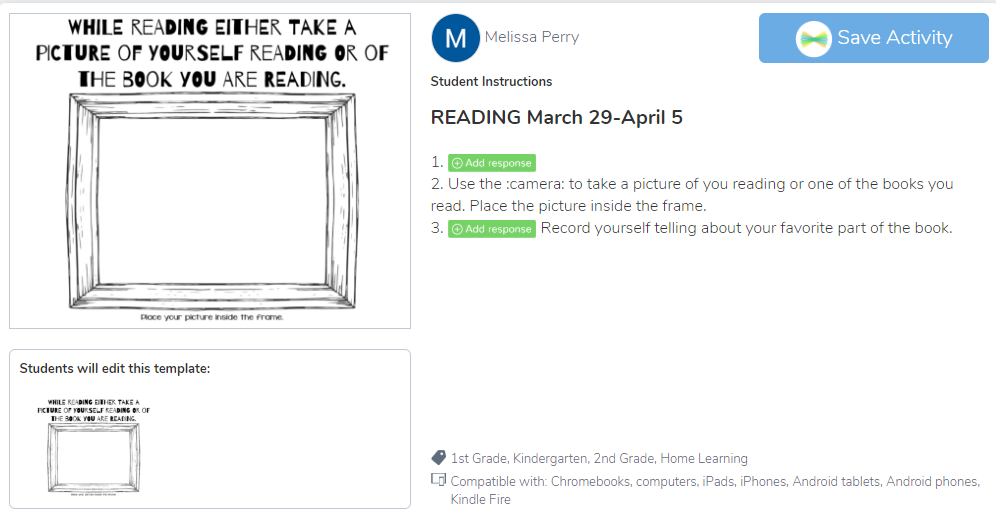
One of NISD’s goals for this year is literacy. Seesaw has allowed teachers to encourage students to keep reading and share their reading while they’re at home. One of Mrs. Perry’s favorite activities sent home to her Kinder class encouraged her readers to simply capture a picture of themselves reading. Mrs. Perry shares, “This activity not only encourages reading, but gives me a chance to see and listen to them read.”  
Click HERE to Enlarge and Listen

ELA coach Rebecca Maddox points out, “Seesaw is benefiting students, parents and teachers during this remote learning time with it's ease of use. Seesaw has allowed our youngest readers and writers the ability to respond and capture their thinking in a variety of ways. They use pictures and voice recordings to capture their thinking for others to view. It is great to see that students can document their reading and writing lives in this format to capture how they continue to grow and learn!”
Students from across NISD are reading and sharing their reading. The first week of extended break, Mrs. Moore sent an optional Seesaw activity to her class asking them to share about a book they read and one they are hoping to finish. These activities have since led to a deeper knowledge of books as the latest activity prompted readers to not only read, but to stop and jot information about the characters in their book. Get a glimpse into’s Reese’s reading HERE or by clicking the images below.

Click HERE to Enlarge and Listen

Stop and Jot (Week of April 12)

Engaging students in their learning is one of Mrs. Embry’s favorite aspects of Seesaw. She states, “Seesaw provides me the opportunity to create engaging lessons that allow students to respond in a way they are comfortable with. They can create a picture with drawing tools, type, or create a video.” Mrs. Embry, Mrs. Davis, and the Granger second grade team have personalized reading assignments by linking in an Adobe Spark video encouraging students to find fun places to read as they work on their reading stamina. It's fun for students to connect with their teachers by seeing them teach and encourage in the videos they send home.


Click HERE to Enlarge 
Mrs. Embry’s Spark Video
Mrs. Davis’ Spark Video 

Connecting with Students (SEL): 
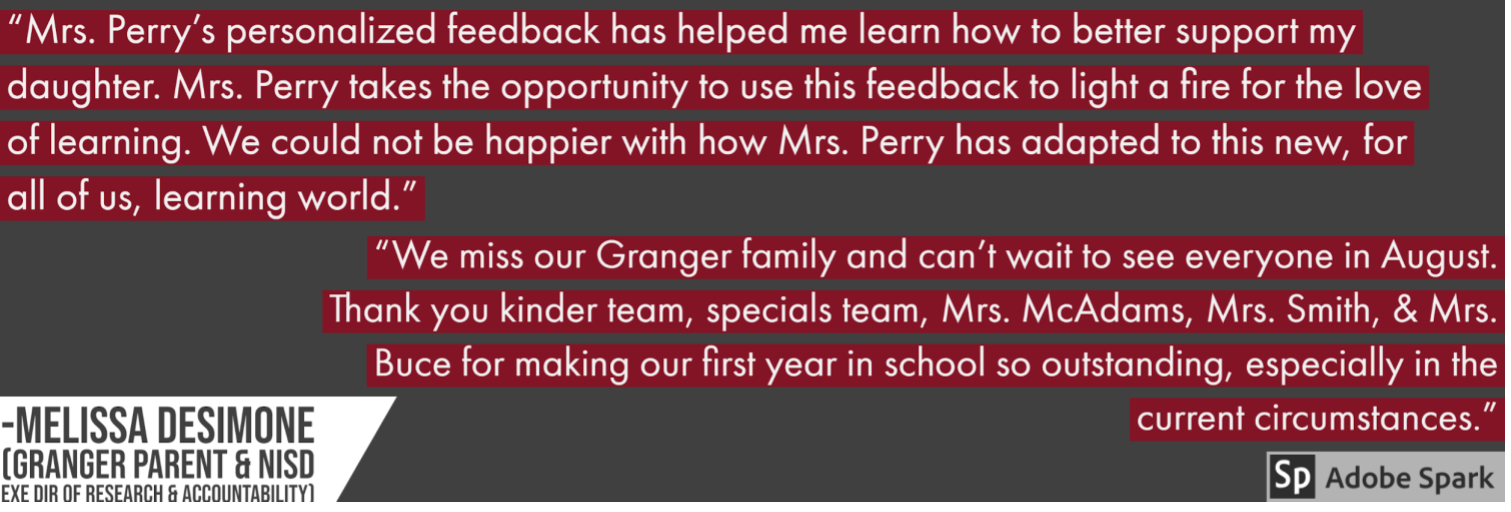
It’s tough not seeing student’s faces each day. It’s important that students know how to identify their feelings, but also that they have a platform to share and be heard. NISD has prioritized social and emotional learning this year, which has helped equip our students beyond their content knowledge. Granger students are especially familiar with “Seesaw Feeling Checks.” These activities have become especially important as teachers get a pulse for how their students are doing, even when they can’t see them each day. Click on the image below to see an example of Mrs. Perry and Mrs. Moore’s feelings check. 

Click HERE to Enlarge

Mrs. Fitch points out, “My favorite part of using Seesaw is being able to connect with my students! I love being able to post videos directly to their journals and I love getting videos from them even more. It is nice to be able to post work for one student, or the entire class with one click.” Mrs. Fitch continually provides her students with personalized video feedback. Check out how Mrs. Fitch used Seesaw to wish one special student a Happy Birthday and make her feel special even from afar.
The heart of our NISD teachers is what makes students excited to learn!
Click HERE to Enlarge and Listen

Providing Personalized Feedback: 
Another benefit of Seesaw is that it protects the privacy of our students and allows teachers to differentiate and provide personalized feedback for students without displaying that feedback to the entire class. Mrs. Perry is very intentional about giving writing feedback on student work. Click on the image below to see samples from the last few weeks. 

Click HERE to Enlarge
Seesaw allows feedback to be written, voiced in an audio comment, or even a personalized video.
Inviting Families Into The Learning:
Mrs. Davis comments, "By using Seesaw daily, parents are able to see what content we are working on and what products their child is creating.  Parents have been very thankful for this program as Seesaw is sparking conversations as home, and parents are able to connect our learning at school to real world situations at home."
Click HERE to Enlarge

Student Growth: 
Lastly, another NISD goal for the year is that students showing yearly growth. Since Seesaw is the house for these student’s learning, teachers are able to see growth over time. Mrs. Davis states, “We have used Seesaw since day one as our students’ academic portfolio, so seeing growth is easy when you compare assignments from the first few weeks of school to their current work.”
Mrs. Fitch adds, “Being able to provide feedback and having the students go back and check their work has allowed me to see growth in their writing. I have assigned the Daily Oral Language activity for three weeks and have seen growth from week to week.” 
NISD is the Place to Be: 
Our NISD teachers are a walking example of this quote by George Couros, “Technology will not replace great teachers, but technology in the hands of great teachers can be transformational.” Our teachers have thrived in a season of uncertainty. While the situation is not ideal, these teachers have not thrown in the towel. They’ve connected in a way that shows their heart for students and their heart for learning. 

*The NISD IT Team is happy to announce that NISD has purchased Seesaw for Schools for the upcoming school years. This purchase is for all NISD schools ages Pre-K to 5th grade. Click HERE to learn more.

Monday, April 6, 2020

Adapting to a New Technological Environment


While biological adaptation happens due to environmental stressors over long periods of time, mental and social adaptations can happen much faster under certain conditions. What we are currently witnessing in relation to teaching and learning is a change that not only shows what we, as humans, are capable of but also the degree to which our schools are capable of serving students. While education reform seems somewhat out of reach most days, times like this, although unfortunate in many ways, can force our constructs and viewpoints to change and ultimately result in natural and positive reforms. Dr. Derek Voiles put it best in a recent tweet when he said, “The schools we walked out of won’t be the same schools we walk back into when this is all over. Our schools won’t just be different, they’ll be better.”


Northwest ISD is fortunate to have many resources already in place to help make our staff and students successful during times like this. However, the particular challenge brought about by Covid-19 has shined a light on areas of need and allowed us to take steps to help improve things like online access, technology training, and remote communication. In addition, educators in our district have been given the challenge of using this time to really focus on student relationships, learning, and growth in very innovative ways.

Math typically takes a lot of practice and, traditionally, practice looks a lot like plugging away with a pencil, paper, and a calculator to work out a solution. While that pencil and paper practice is an important part of understanding the way math works, NISD Algebra II teachers took it a step further by trying their hands at an app called Explain Everything on the iPad where they smashed it together with Zoom to create incredible videos that bring calculations off the page for students.
In addition, Becky Spasic and Carla Dalton, at Byron Nelson High School, took this opportunity to share their knowledge of this app with fellow teachers by using it to create a “how to” video for implementing this strategy in a remote classroom setting. This strategy is one that adds an element of comfort and personalization to remote instruction while also helping students approach content from a variety of platforms.

When NISD teachers began looking at the shift to remote learning, many wondered how elementary students would be able to learn without being physically present with their teacher and classmates. How could our youngest children possibly manage their own learning tasks? It became apparent very quickly that most of our elementary teachers were teaching a level of independent learning prior to the break and that many of these students were able to adapt very quickly to a remote situation.
Seeing third grade students manipulate Google Slides and Google Drawings to illustrate understanding of ecosystems and food chains is truly an amazing process to watch and it almost makes you forget that you are watching eight and nine year olds as they move adeptly from one application to another while happily finding ways to showcase their knowledge. The teams of teachers creating these lessons know their students, know their capabilities, and have prepared their students to be self-sufficient learners.

Although the changes in the trajectory of society due to Covid-19 are some that we will be navigating for years to come, the world of education is one that is capable of mastering this shift and the obstacles that come with it. Educators are meeting this challenge head on with every bit of creativity and determination they have for the sake of their students. Some critics are predicting that this change will automate learning in a way that will make teaching an obsolete profession. However, through this, we are not only learning how much technology can help produce student independence but we are also learning how necessary human beings are in making the use of these tools relevant to learning and student success. Without previously established expectations and student relationships, these teachers would be dealing with completely different results. Educators are a necessary element to making learning meaningful for each and every one of their students and they cannot be replaced by technology. Circumstances like this will only enhance skills of both teachers and their students and everyone will grow as a result.

Monday, September 18, 2017

ZOOMing in on the 4C's!

ZOOM: Student View
5th grade students in Mrs. Chamberlain’s 6th Grade Pre-AP Math class collaborate and learn together every day! The unique aspect of this class is that none of these students are physically in the same classroom as Mrs. Chamberlain. Northwest ISD’s 1:1 environment, along with a variety of digital tools allow students from across the district to interact, give and receive feedback, collaborate, create, and even work in groups. Every morning, students remote into Mrs. Chamberlain’s class via ZOOM. Students all have a Microsoft OneNote journal in which they share a collaborative whiteboard and have individual pages to solve their work. The students are enjoying the class, the challenge, and the ability to learn from anywhere. In Zachary's words,"What I love about the remote class is that I can see other students from different schools without having to get out of my seat." Kash adds, "I like that we can share thoughts across the district" and Holden comments, "I feel challenged in math this year and the problems are fun because they seem like puzzles."


OneNote: Collaborative Whiteboard

ZOOM allows students to communicate with each other in a variety of ways. "I like how you can mute and un-mute yourself, and how you can raise your hand, because it makes you feel like you're in an actual classroom with the teacher. I would say the most difficult part so far has been my Unit 2 homework," said Matthew. 


Group 3: Google Draw Work and Collaboration
Google Slides: Turning in Posters


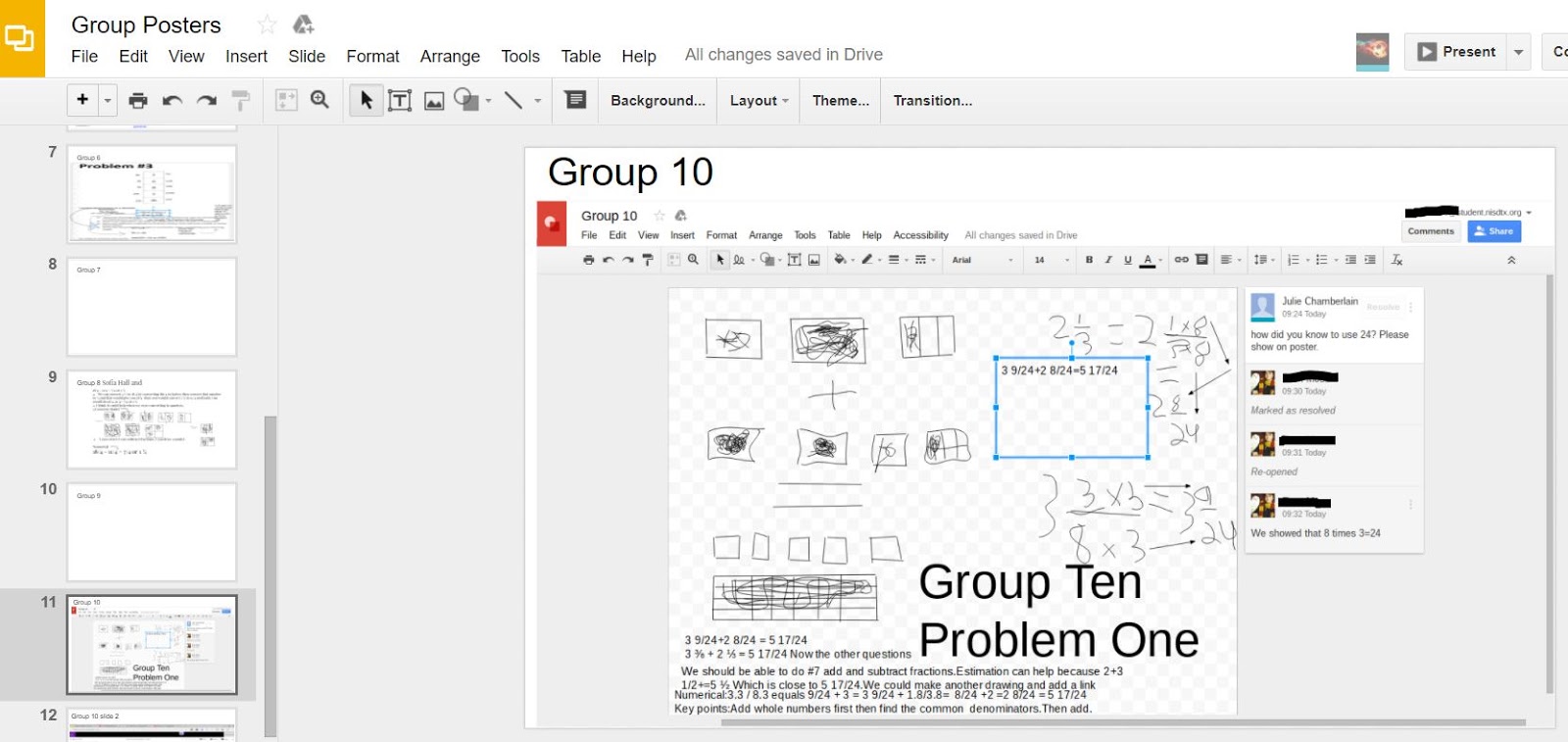
Recently, students were put into groups of two to create a visual math poster on fractions. Students used Google Draw to collaborate and show their thinking visually. Once visuals were created, students uploaded their drawings to a collaborative class Google Slide so that they could give and receive feedback as well as learn from other groups. According to Blane, "the group poster was exciting because I got to work with someone I have never worked with before."

Students in this class are learning to communicate and explain their thinking across a variety of platforms. They are learning how to interact via audio conference, text chat, visual graphics, etc. This class truly represents 21st century learning and encourages students to take ownership of their learning. They are encouraged to take risks as they work with students from other campuses. This class is just getting started and these students have a lot to accomplish before the end of the year!

Student ISTE Standards:
  • COMMUNICATION (1C): Students use technology to seek feedback that informs and improves their practice and to demonstrate their learning in a variety of ways.
  • CREATIVITY (4A): Students know and use a deliberate design process for generating ideas, testing theories, creating innovative artifacts or solving authentic problems.
  • CRITICAL THINKING (5C): Students break problems into component parts, extract key information, and develop descriptive models to understand complex systems or facilitate problem-solving.
  • COLLABORATION (7C): Students contribute constructively to project teams, assuming various roles and responsibilities to work effectively toward a common goal.