Showing posts with label Sketchpad. Show all posts

Monday, January 29, 2018

Teaching Your Future Forgetful Self

From homework, to extra-curriculars, lunch, friendships/other relationships, as well as chores and other duties at home, so much "life" happens in between today's class period and tomorrow's. Units of study are typically scheduled to end on Fridays so that students can cultivate skills throughout the week and test on Friday with the weekend being a mental break and a new unit/topic starting the following Monday. As much as a week-long Thanksgiving Break is desired, it occurred in the middle of a 7th Grade Math Unit causing Medlin Middle School teachers, N. James and B. Salazar, to get creative in overcoming this potential forgetfulness.

Following a rigorous Scope-and-Sequence, students began studying TEKS 11A (model and solve one-variable, two-step equations and inequalities) and 11B (determine if the given value(s) make(s) one-variable, two-step equations and inequalities true) with only three days remaining before Break. In having this unit resume upon return, James and Salazar wanted to find a way for students to not only learn the foundational skills within the limited time, but also retain the information post-break to maximize instructional time focused on next-steps with minimal review.

What better way to remember content than become your own future self's tutor! To do so, students were tasked with creating a video tutorial utilizing Sketch IO and Screencastify that included the following requirements.
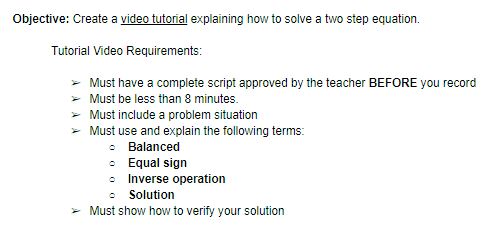

Multiple scaffolds were put in place to ensure students were reinforcing correct information. To start, these on-level students were allowed to be in groups no larger than 3 so peer-teaching could be utilized to support and clarify learning. Additionally, students were tasked with prewriting a script which encouraged planning and preparation instead of an on-the-fly performance; furthermore, this script had to include a few Key Terms in order to provide structure to the video whose remaining components were largely decided by student-choice.


Upon return from the week-long Thanksgiving Break, students had access to their own tutorial as well as a shared Google Folder containing their classmate's videos. This repository was valuable because students could hear and see explanations in student-friendly language from multiple viewpoints and problem sets. Creation of this video is at the highest level of Blooms Taxonomy in which students must synthesize information to create their own original work. Through creating a tutorial to teach yourself and others, students not only had to remember, understand, and apply these math concepts, but then use this to analyze the required steps and evaluate their order and purpose so that they could formulate this video. Applying higher level thinking commonly solidifies the learning to long-term memory so that instruction could resume right where they left off before Break with the tutorial videos available for memory jogging and review.

This activity meets ISTE's standard of being a 'Knowledge Constructor' in which "Students curate information from digital resources using a variety of tools and methods to create collections of artifacts that demonstrate meaningful connections or conclusions." (3c)

Monday, September 26, 2016

Remixing the Retake


When students do not perform as well as they would have liked on their first attempt of an assessment, they can request a "reteach-retake" for another opportunity to learn the content and demonstrate their understanding. Traditionally, quiz and test retakes are modified forms of the original assessments, either on paper or as a Moodle quiz. As future ready creative communicators, we want students to (1) choose the appropriate platforms and tools for meeting the desired objectives of their creation or communication and (2) create original works or responsibly repurpose or remix digital resources into new creations (ISTE Student Standards 6a & 6b). What if students were given the option to decide how they demonstrate their learning, using any tool available?

Math students at Eaton HS are taking this approach. Instead of repeating the assessment in a similar format as the original assessment, students are utilizing technology to demonstrate their learning, given the grading rubric and a deadline. These constraints dictate the destination; students decide their own path how they get there, with great success.

Student quiz retake sample 1:


"My mom recorded the video as I talked through it and showed what I was doing. The video retakes makes it easier because you don't have to be at school to do it; you can do it anywhere. I feel like I learned it better than a paper retake because I was able to explain it; to explain it you have to know what you're doing." ~Algebra II student

Student quiz retake sample 2:
"We didn't have to do every single problem, so we worked them together. Each student separated their own problems in a box and worked through the problems and answers. We used the drawing tool to insert boxes and lines, including a number line. I felt like I understood the problems better than when I do a normal quiz retake because we helped each other work though the problems."
~Algebra II Student

Student quiz retake sample 3:


"You get your paper test back and all the questions you got wrong are marked wrong. So I went to the sketchpad website with a stylus and wrote the problem I got wrong, showed how to work the problem, and showed the right answer at the bottom. At the same time, I recorded myself speaking through the Chromebook what I did wrong, why I got it wrong, and how to do it correctly. So I know in the future how to do it correctly." ~Algebra II Student

Using their choice of technology to demonstrate their understanding in a different way has resulted in increased engagement and understanding, meanwhile building skills students need to become creative communicators.

-----------------------------------------
Tools used in the student samples above:

Other resources: