Showing posts with label eaton high school. Show all posts

Monday, November 8, 2021

Growing Beyond "Normal" with Digital Feedback

When Maya Angelou said, “If you are always trying to be normal you will never know how amazing you can be,” her intent was likely to address a different definition of “normal,” but her words are absolutely applicable in today’s schools. We are at a turning point as educators and the recent pandemic has to become less about us going back to “normal,” or where we were before, and more about embracing growth and creating new and better ways of doing things.

Educators everywhere have recently been impelled to adapt and find digital ways to give feedback to students. Some of those strategies have persisted and even prompted teachers like Cathy Slagle, a business pathway teacher at Eaton High School, to provide her students with immediate and relevant feedback on digital assessments by taking advantage of the answer feedback option in Google Forms quizzes. This feature allows teachers to add comments, instructions, embedded videos, or links to previous course resources so that students can review missed concepts and even extend their learning.

Craig Hardin, another Eaton High School educator, uses Google Slides with his athletes as a creative way to review performance and prepare for upcoming competitions. Coach Hardin recently learned about the comment features in Google Workspace and has begun using written comments to provide timely, meaningful, consolidated, and personalized feedback to his athletes. Coach Hardin says that the team has found this extremely valuable for post-game reflection and says using this strategy for giving student feedback is saving him hours each week as he works individually with athletes in an easier to manage digital platform.

Patricia Smith in Eaton’s Business Management and Entrepreneurship Academy stated that she is “very excited to try out Mote,” an audio recording tool, as a different way to provide feedback for her Academy students. Not only is she using Mote to help record feedback for her students as part of an upcoming assignment but she is also having her students use it in Google assignments to comment and reflect on their work and provide peer feedback within their groups. Using resources like Mote allows teachers the ability to spend less time grading by hand and also engages the students directly in the feedback process. By incorporating a digital feedback resource into her lessons, Mrs. Smith has saved herself valuable time and empowered her students to become more active in the learning process.

Over the course of the last year, as responsibilities and approaches to classroom instruction have been forced to evolve, each of these educators are meeting their classroom needs by adapting the ways they give students feedback. These efforts not only save them time, in comparison to traditional forms of feedback, but the strategies implemented have provided their students with timely, meaningful, and actionable feedback that can be used for reflection and growth, allowing both teachers and students to spend more time creating and learning and realizing “how amazing they can be.”

Tuesday, October 12, 2021

Gaming as a SPORT: Expanding Opportunities for Students to Belong and Compete through eSports

Fall means the start of a new sports season! Tryouts are held and a roster is set based on player interests, abilities, and team needs. Practice schedules are created. Preseason matches occur then come regular season games and tournaments; the team works towards Playoffs and has the ultimate goal of making it to Finals. Fans attend to root for the home team and players hope for college recruiters to see their skills and potentially offer scholarships. The competition is tough, but skillful strategizing and teamwork can lead to a big win and open doors for future opportunities.

Nope, this isn't describing the upcoming football season -- this is a look at the new Fall eSports Season! As much as video games seem like a just-for-fun activity, this past time is becoming recognized as a varsity level sport in addition to Generation eSports being selected as the exclusive sponsor for the University Interscholastic League (UIL).

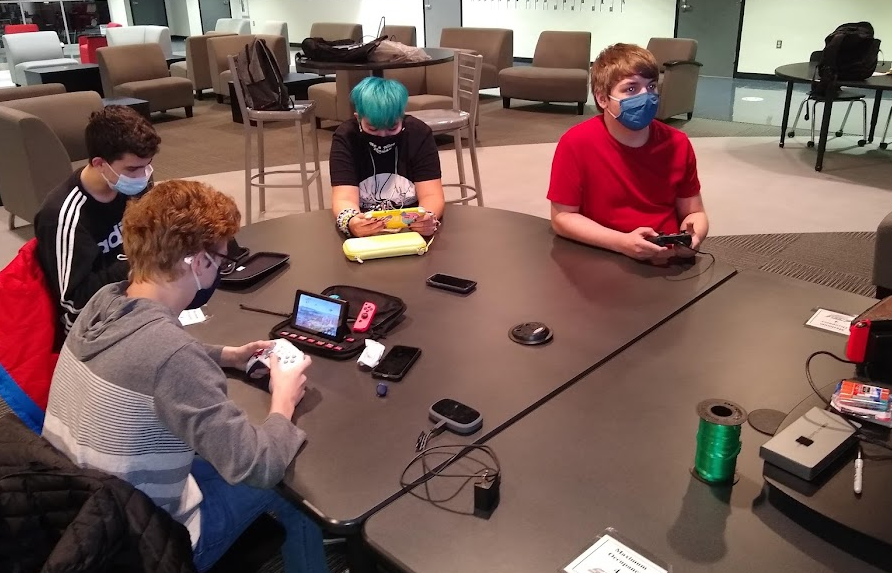
Two Eaton student going head-to-head in the Smash Ultimate Grand Finals.
Depending on the streaming requirements of the game being played, students will either use the designated Alienware PCs or their own gaming devices, such as Nintendo Switches. 
   -----

-----

"The purpose of eSports is to provide opportunities for ALL students to have a platform to acquire critical communication, collaboration, and problem-solving skills needed to thrive in work and in life as outlined by the NISD Profile of a Graduate" - NISD eSports Code of Conduct

Students at Eaton High School, Northwest High School, and Steele Early College High School participate in eSports Clubs as part of both casual and competitive teams. Student leaders on the various campuses coordinate with their game-based team on practice schedules and upcoming goals for league games.

Students at each of NISD 's high school eSports programs have top-of-the-line gaming PCs from Alienware including the PC and device peripherals such as Alienware mice, keyboards, and headsets.

Popular games on NISD campuses play games include Super Smash Brothers Ultimate, Overwatch, Valorant, Rocket League, and League of Legends offered through either the High School eSports League or the PlayVS league; because students have the opportunity to complete in two different leagues, this increases their opportunities for tournament play and competitions to enter. Students communicate game preferences and teams are formed based on student numbers and interests. For example, Super Smash Bros compete in teams of 3 whereas Valorant complete in teams of 5 and Overwatch in teams of 6.


Did you know? Eaton High School had teams compete in PLAYOFFS of different games in each of the past two years!

-----
Why is eSports an important program? 
What skills are kids getting as a result of their involvement?

-----

All of the NISD eSports clubs are welcoming new students. Show up and we will find a place for you to belong!


Get more through this NISD blog eSports: More Than Just Fun and Games and by exploring the NISD eSports Code of Conduct.

Monday, January 27, 2020

A “Different” Approach to “Leaving No Student Behind”

Educators are always looking for new ways to reach students and help them find methods or paths for acquiring success in the classroom. However, it seems that there are some students who, despite our best efforts (and their own), struggle with the institutional process of acquiring knowledge and skills necessary to meet traditional measures of success. After recently reading the words of Katie Usher, a Texas elementary school teacher, it became clear that well-known classroom differentiation practices, although very effective and successful for some, may not be enough for students who need a completely different learning environment in order to access the content needed for mastery. Although Katie’s experiences are based on a gifted classroom, her words are important for all students. She asserts that “In the digital era, we can provide all of our students with technological ways to enhance their learning, no matter their academic label. Every student is different and needs to be offered a variety of ways to show what they’ve learned in a way that reflects their individuality.” This is exactly the philosophy behind the ever growing "Eagle Strong" cycle recovery program offered at Eaton High School (EHS). 

Alicia Dunson, a Professional Communication teacher at Eaton, has spent a majority of her career working to find ways to reach students where they are and to help them progress and find methods for success that work for them. Alicia starts by learning about her students and building relationships with them that allow her to not only ask her students some tough questions about previous academic patterns but she is also able to use her positive relationships to push these students to develop levels of accountability and self-sufficiency that gives them ownership in their own learning moving forward. This philosophy of teaching made Alicia a perfect fit to help develop the "Eagle Strong" cycle recovery program at EHS and to begin working with students to access systems and methods more appropriate for their individual learning needs.

In this program, students are identified as needing intervention before completely failing a course and they are not only given an opportunity to access narrowed and unmastered course content through a self-paced online platform, but they also have the support of certified educators working on campus that can assist as needed. Mrs. Dunson facilitates student progress by helping them learn ways to record and track their own mastery of coursework that work for them and by connecting students with teachers and tutors before, during, and after school hours. Through use of these online tools and content, qualifying students can showcase existing knowledge that might previously have been a struggle for them to display and to do so in a timely fashion without getting behind in credits and while receiving both built-in and in-person remediation. The ability to digitally self-accelerate beyond concepts already mastered and to slow down to focus on more difficult areas of the curriculum make this educational experience unique and more effective for some than a traditional environment.

One student in Mrs. Dunson’s "Eagle Strong" program credits this experience with helping her to revisit and master content from multiple courses without the stress and pressure she typically experiences in a regular classroom environment. She feels that the ability to move through material at her own pace puts the responsibility on her and she says that “You have to learn. You cannot just zone out or not pay attention. It’s all on you.” Another student said that she has learned study skills that can help her in other courses and she feels the online coursework helps her because the courses “have a different way of teaching and gives students different ways to learn the material.” She likes the ability to watch and re-watch a lot of videos that show her examples and also enjoys the freedom to go through curriculum on her own.

While many students thrive in a traditional school environment, some need more than tradition can offer or they may have experienced circumstances that hinder their progress in all or parts of a particular course. In some situations, students simply need other ways to access content in order to master the skills and knowledge necessary to grow and thrive. EHS is providing a method for students to do just that through the development of their cycle recovery program and they are creating options for students to learn and excel that allow flexibility and choice while not compromising student time, interests, and most importantly, confidence. This program, in essence, is an example of differentiation at its best and as our fellow Texas educator, Katie Usher, put it, “Differentiating allows students to have their voice heard, which can lead them to become self-motivated learners. And that in turn can help increase both their learning growth and their self-awareness of that growth.” These achievements in differentiation are much needed components of our educational system that truly provide for a future where fewer students are “left behind.”

          Usher, Katie. “Differentiating by Offering Choices.” Edutopia, George Lucas Educational Foundation, 10 Apr. 2019, www.edutopia.org/article/differentiating-offering-choices.

Tuesday, October 22, 2019

Esports: More Than Just Fun and Games


Einstein said, “Education is not the learning of facts, but training the mind to think.” Teaching
students how to think and how to succeed helps develop those “soft skills” we all frequently hear about as students transition out of formal education. These time tested skills are not just another educational trend or revolving initiative. Characteristics like communication, integrity, empathy, professionalism, time management, responsibility, teamwork, and critical thinking are things that contribute to our social and emotional development and they are what helps us, as humans, to be able to successfully adapt to a variety of situations. What many educators differ on is how to go about facilitating the development of these skills and characteristics in our students.

One way to develop these skills is in the growing realm of esports. It is a relevant place that can not only support Social Emotional Learning initiatives, but it can also facilitate many of those soft skills we want students to gain. In fact, the mission of the North America Scholastic Esports Federation (NASEF) is “to provide opportunities for ALL students to use esports as a platform to acquire critical communication, collaboration, and problem solving skills needed to thrive and work in life.” Esports does not just facilitate gamers getting together to play video games, but alternatively, it ensures “that ALL students possess the knowledge and skills needed to be society’s game changers: educated, productive, and empathetic individuals.”

Mr. Fidel Sanchez, a science teacher at V.R. Eaton High School, is leading the charge to establish Eaton’s very own esports club. To the inexperienced gamer, this new club seems like a fun break for students from the regular grind of a traditional learning environment. However, it is way more than it appears on the surface. Esports is projected to become a billion dollar industry in the next year and not just due to hosted events that resemble what you might see at the Super Bowl or World Cup Soccer. Esports has the potential to help a large number of students access college through NCAA scholarship opportunities and related career paths. The Eaton esports group meets twice a week to practice and develop a very complex and impressive skill set. The goal is to build a team that can compete interscholastically for large scale academic recognition, scholarships, and career opportunities.

Michael, a sophomore on Eaton’s team, explains that he loves to participate not only to have fun but also to have the opportunity to be competitive at something he enjoys. He and his teammates, Andy and Larry, feel that esports helps them to develop better communication skills. Parker, a junior orchestra student, agreed that participating in esports has helped him to “be more social” and build the skills necessary to positively interact with others. Kameron, a sophomore team member, agreed and explained that the communication students learn through esports is different than most socialization and in order to be successful, one has to be able to “stay calm during competition and communicate professionally with their teammates to build trust.” He pointed out that “unprofessional communication does not help teammates to believe in your ability to deal with challenges,” which is important for a team to be successful. Beau is a freshman student on the team who says that there is no place for students to “be toxic or to fight with other players.” All the students agreed that participating in esports encourages them “to stay on top of their grades and to prioritize” because maintaining the level of skill needed for competition takes at least an hour or two of practice each night.

These Eaton students hope to see this activity grow larger among younger audiences here at EHS and across the country. They recommend that for anyone interested in getting involved in esports to “just start playing.” They suggest spending time learning about various roles, different strategies, and “champions” (characters) in games like League of Legends or Super Smash Bros. and to work to develop the style of play for their role and “champion.” These students also suggest finding adults like Mr. Sanchez , who are just as passionate about gaming to help them organize and advocate for resources and opportunities necessary for their club’s growth.

Monday, May 20, 2019

Guiding Today's Learning with the Tools of Tomorrow


We have all heard the saying about “...preparing students for jobs that don’t yet exist.” While that may be true, the best preparation for a future yet to materialize is to let go of the idea that we, the educators, are responsible for preparing them for the future, at least in the way traditionally thought. It is more necessary for educators to step out of the way and to let the students take control of their own learning in order to foster engagement, authentic growth, and innovation.

Rob Austin & Lee Devin, the authors of Artful Making: What Managers Need to Know about how Artists Work, describe innovation as a process where managers need to forget about the traditional destination and journey mindset. The idea that someone has to have a crystal clear objective in order to justify movement toward a goal, at least as we know it, is becoming obsolete. In truly innovative environments, collaboration, flexibility, creativity, and growth mindsets can lead to the discovery of new paths rather than a predictable route to success. When we work with our students to facilitate the realization of their creative ideas, our students can develop necessary skills for the modern workplace while becoming leaders that guide their own success. Setting students free to create and innovate is interesting in theory, but how does this look in today’s classroom? 

At Eaton High School, William Gilbert’s Computer Programming students investigated possible uses for innovations in virtual reality technology prior to being tasked with coding and creating their own tools, geared for the same purpose. Students were given the freedom to imagine other applications and uses for this type of technology and began inventing their own VR programs designed to meet real needs predicted for future learners and workers. After learning about the educational benefits or virtual reality, many students began working on utilizing VR technologies in the workplace and school settings and have even begun testing their work in the context of their existing classrooms.

Business Academy students in Tabatha Everett’s Entrepreneurship course were given the challenge of studying and determining future viability of an up and coming technological business model in their Pokemon Go AR Challenge. These students used a case study of Niantic's Pokemon Go app, from a previous Virtual Enterprise International Competition, as a model for mobile augmented reality use in business. They studied usage trends, obstacles for expansion, effects of the app on user quality of life, modifications and additions to the game, as well as the company’s efforts to meet user demand. 

The student led part of this project allowed them to critically explore real questions surrounding the game, the technology used, and future opportunities for AR revealed by Niantic’s venture. Students then created a proposal of their own for marketing with augmented reality integration in other business areas. Some of these proposals explored the potential for business partnerships through integration of AR, virtual dressing rooms for purchasing clothing, and virtual showrooms where consumers experience product features of items like furniture, cars, or appliances. One group even outlined the potential for online AR marketing events with real rewards for consumers. The students exploration of this innovative platform allowed them the ability to dream about untapped ways this technology can be used to impact the future lives of consumers.


Another group of students in Donny Pharr’s Introduction to Aircraft Technology courses researched commercial drone use and considered business models, laws restricting flight areas, and other logistical factors related to commercial drone aviation. After completing the initial research process, students were given the task of creating their own plan to re-purpose drone technology for the benefit of school district sponsored events. They were given the freedom to invent ways this technology could enhance experiences at high school sporting events. The process resulted in groups outlining utilization of drones for concession stand food delivery at NISD football games. They mapped out geofencing boundaries around the NISD stadium as a foundation for designing their delivery service, via drone technology. This real world scenario was conceptualized by allowing students to creatively think about solutions for the problem of crowded venues and long concession lines at NISD events. They met various obstacles and limitations while working their way through the learning process, which resulted in them constructing their own ideas for innovative and practical use of existing technology while visualizing the potential for drones to breed entirely new careers. 

While these classes are just small examples of student exploration and innovation, they are prime instances of the ways learners can begin to dream about the future and how their own educational journey can forge a new path that previously did not exist. Of course, just removing all classroom guidance and parameters for students is not what is being suggested. Whether your students are part of specialized areas such as these, or whether they are searching to connect existing content and skills to real life, giving them the freedom to explore possibilities for applying skills beyond the classroom is what will open up their imaginations to new ideas. Simply put, if we present problems for our students to solve and then step out of their way in order to let them dream, fail, learn, and innovate, we can facilitate results that outshine anything previously imagined and students can forge incredible new paths for their futures.

Thursday, March 28, 2019

Finding the Right Tool for the Job

In many instances, educators are encouraged to approach student learning and growth by focusing on individual student deficits or identified areas of need. While being aware of student needs is important, an effective educator must also be able to focus on what a student can do rather than solely concentrating on what they can’t. Educators spend a lot of time collecting, evaluating, and comparing assessment data in order to guide practice in a way that is designed to fill and eliminate learning gaps for students. However, promoting student growth and success requires an educator to see their students from multiple perspectives and to know where they are in the now.

A successful model of education considers both strengths and needs and does so by allowing students room to showcase those things on a daily basis. Temple Grandin, a professor at Colorado State University and a famous autism spokesperson expressed this effectively when she said, “In special education there’s too much emphasis placed on the deficit and not enough on the strength.” One of the best things about being involved with special education classes at Eaton High School is seeing how the teachers of these classes focus on the entire student. Knowing what students need as well as what they are capable of doing is key to helping them learn independence and skills that will serve them well into adulthood.

Lisa Daniel’s Applied English students are given opportunities to not only learn necessary ELA skills, such as expository writing and resume building, but she also works with them on how those skills apply to real life situations by arming them with the right tools and resources to compete for opportunities in the postsecondary world. For example, Lisa’s students were given the chance to begin developing their own ePortfolios to help record and reflect the skills they have been learning as well as to create a way to showcase themselves after they leave EHS. While building these sites, one student spoke of his deep interest in meteorology and weather and began incorporating his independent research and knowledge of the topic into his ePortfolio in order to show not only his desire to pursue that passion but also his independently developed skills in the areas of research, communication, and science.

Another student in one of Lisa’s classes encountered this same curriculum in an equally inspiring way by requesting access to an added tool in order to begin setting up his ePortfolio. This student, who deals with some physical limitations that most might consider a total obstacle to his ability to use digital tools and devices, was able to communicate a need for a stylus in order to access Chromebook features, allowing him to more effectively express how he wanted information displayed by setting up his page formatting, background, profile photo, and portfolio pages. While this was not an easy process for him, with a simple tool and some one on one teacher support, this student was given the independence to complete a task successfully. What some may not realize is that the student’s differences are not a hindrance to him in every situation. With the right tools, this student, who may not express a physical voice that is heard, can have a distinctive voice through his work and successfully do the same, if not more, than the students around him with no noticable differences in the end result. The author, George Couros, said it best when he said, “Technology is not just a tool. It can give learners a voice that they may not have had before.”

Christina Schweitzer’s SOAR (Social Occupational and Academic Readiness) students were awarded iPads and upright stands through the Northwest Education Foundation Grants. These particular devices, when utilized with the provided stands, allow students with physical differences to access tools that help to develop online navigations skills as well as reading, writing, and other communication in ways more conducive to their physical needs. For example, students were given the opportunity to work directly with interactive online anatomy curriculum to access content about the human anatomy in ways that were previously unavailable to them with textbooks or regular curriculum tools. In addition, these SOAR students are able to utilize digital resources that are focused on incorporating individual interests and skills. By bringing in digital tools like these, teachers can facilitate personalization of learning and students can engage and connect more with content while showcasing talents and mastering curriculum. Simply put, when we figure out what a student can do, we can find the right tools and resources to help that student grow in ways previously unimaginable.

Although technology tools are great to have in the classroom, it is never about the tool itself. Good learning is always about how those tools are used and about using the right tool for the right student and situation. When educators, such as these special education teachers, take the time to get to know what their students are capable of doing, they can customize curriculum to access those strengths and create situations where students display their talents while building confidence and a solid mastery of academic skills.

Tuesday, January 8, 2019

"IT'S ALIVE!" Bringing Critical Thought to Life with Mary Shelley's Frankenstein

Victor was a learner. He had a passion for acquiring new information and using it to innovate and create. In Mary Shelley’s famous novel, Frankenstein, the title character, Victor Frankenstein, stated that “It was the secrets of heaven and earth that I desired to learn...” In the story, Victor exposed an unchecked curiosity for learning as well as his own tragic flaw. Although learning is generally a positive process, understanding how acquisition of valuable information goes together with personal and societal ethics is something that a learner must fully grasp when encountering content, if they intend to apply it successfully. Through critical thinking and discourse, fostered by student choice and individualized learning opportunities, students are able to think differently about a text and draw conclusions about its relevance to their current world.

The type of critical thinking required to comprehend and analyze encountered information and its connection to real life areas of advancement is an absolute necessity that ninth grade ELA students experience as they encounter Shelley’s text in Pre-AP/GT English courses at Eaton High School. These students explore, consider, and discuss the “moral liability” of “knowledge” and “progress” as a part of a problem based learning opportunity that allows for student choice while also facilitating real world connections to the text. As part of this project, students in ninth grade Pre-AP/GT English are presented with the driving question of “Does knowledge or progress ever become a moral liability?” They are asked to utilize resources and processes of their choosing to explore both sides of an area of advancement and then choose varied platforms and tools in which to communicate their findings in ways that answer that driving question. The findings are curated into a “Live Binder” that is shared with peers and other school and community members.

Students are given a wide variety of options for how to present up to date research in ways that not only answer the given problem but also present both sides or an issue and advocate for a perspective that has been developed through meticulous research and and discussion. Some students choose to use WeVideo or YouTube to help create and edit videos in the format of interviews or commercials, while others use similar tools to create podcasts or radio shows. Some prefer approaching their topics through graphic design with visual advertisements in Canva, or written argument in journal or blog entries using Blogger or Smore. Whatever the platform, a truly beneficial part of this experience comes in when a student is given the freedom to choose a tool or resource that they are confident in using and that communicates their voice effectively while helping to share their knowledge with the community around them.

As students develop argumentation, research, and independent communication skills throughout this project, they are able to display those over the course of a week set aside for formally sharing findings with the school community. While presenting their inventive and relevant creations, these students confidently defend their research and conclusions in a dissertation style setting, which is not only challenging but truly impressive to witness. It is in a forum such as this where it becomes apparent that our students are not only being given the freedom to explore content and required texts but they are also being provided opportunities to develop their own viewpoints on critical societal issues while shaping an ethical compass of their own, all while being able to connect it to their reading.

Victor Frankenstein also said, “I will pioneer a new way, explore unknown powers, and unfold to the world the deepest mysteries of creation.” However, what Victor was lacking was a true understanding of what to do with that information, which students in our freshman Pre-AP/GT English classes are acquiring and applying through research into their own opinions, in-depth analysis, and critical discourse. These invaluable learning experiences are things that will help to not only develop lifelong learners but also facilitate learning that encourages an approach to new discoveries with a critical eye and solid ethical grounding.

Monday, October 15, 2018

"Breaking out" and "Escaping" to Active Learning


Scenario: You are a student sitting in class, eyes glancing at the clock, counting the minutes to the bell, wanting to “escape”…Unless, you are in Rachelle Enax’s AVID classroom at Eaton High School where your only glances at the clock are in hopes for more time. Mrs. Enax’s students have already spent several class periods this school year wishing for more time to access information that will give them much needed clues for solving mysteries within educational breakout games. The escape room or breakout concept began in Japan in the early 2000’s with escape rooms created for entertainment purposes. As the trend grew, educators began to adopt this idea and evolve it into a type of classroom activity that empowers students to independently search for themed content needed to solve puzzles and unlock a series of clues, eventually “escaping” a fictional scenario.

Mrs. Enax elected to try this type of activity with her students after seeing the Breakout EDU resources available in the library media center. Breakout EDU resources allow teachers and students access to physical breakout boxes with already built clues and hints as well as completely digital breakouts that cover a variety of content areas. While completing their first “Back to School Boogie” breakout box activity, several of Enax’s students commented that they enjoyed the activity because “it allowed them to get information and learn things on their own and it was so different than what they usually do in school that it didn’t even feel like school.” After completing a second digital breakout, one student commented that “it was much better than someone lecturing us or just watching videos.” The student also appreciated that if there was something she already knew, she didn’t have to spend a lot of time on that and could move on to new information on her own. After the first couple of breakout experiences, Enax’s students have begged for additional breakout opportunities to help them study and discover concepts that are part of the AVID curriculum.

Several other EHS teachers are beginning create their own completely digital breakout games and try out the Breakout EDU resources available in the EHS library media center. Karri McGovern, an Eaton social studies teacher, noted that several of her students were complimentary of the digital breakout idea after working through an academic honesty scenario presented as an option for freshmen during PSAT testing. McGovern said that “Even the reluctant players bought into the game eventually. It took some of them a few minutes to start thinking the right way and find the first couple of clues, but once they did, they were engaged and determined to finish.” Students in Parween Noori’s freshman class stated that it was “fun to work together in a group to figure out the clues. You really had to look at the videos and articles closely to find the answers.”

This increasingly popular active approach to classroom instruction is part of a growing movement of educational strategies that puts responsibility for learning into the hands of the students, reversing traditional teacher-centered instructional strategies. These methods create more opportunities for engagement, collaboration, creativity, and excitement over the same content. The critical thinking and problem solving required of students in these scenarios tap into key academic and life skills needed while also exposing them to course content.

When reflecting back on the activities done in class so far, Mrs. Enax’s students credit their breakout experiences with improved team building and communication skills and they are excited to see what additional opportunities they will experience with future breakouts, maybe even getting to create their own.

Tuesday, September 25, 2018

Skilled Students: With the Certifications to Prove It

Every choice Patti Hayes makes about her Business Information Management course is funneled through Career and Technical Education (CTE)’s vision for future-ready students: “Skilled, Credentialed, and Ready”. Though, this isn’t unique to her classroom. In high school CTE classrooms throughout Northwest ISD, students are given every opportunity to graduate both skilled and certified with professional, industry certifications.

From students in Health Science earning CPR certifications, to those in Architecture classes certifying in programs like AutoCad, NISD students are graduating, at no cost to them, with industry certifications. “People need to understand that when we talk about industry certifications,” STEM Coordinator Casey Helmick explains, “it’s not like when I was in high school, a computer test that doesn’t mean anything. We are talking about certifications adults are currently paying for in order to get or keep their jobs. That is one way we set our kids up for future success.”

Through CTE, students have access to 27 pathways, each offering unique certifications that relate directly to degrees or fields of interest. For example, engineering students in the STEM Academy earn OSHA certifications their freshman year, and many have earned Autocad and Revit certifications by the time they graduate, while students in Business Information Management have the chance to become Microsoft Masters -- a title many are determined to earn before graduation.

Here is how it works: NISD high school students enrolled in any CTE class have access to Jasper and G-Metrix online, both certification curriculum platforms. Jasper teaches students Microsoft skills, challenging them with 8 skills-based lessons before their final creation project. GMetrix teaches programs like Autodesk and Adobe through 4 create-as-you-go lessons. Once students are trained, they test to certify through Certiport. In addition to these tools, students can supplement their learning with video tutorials from a site called Lynda.com, to which all Northwest ISD students have access.

Northwest High School (NHS) student Hulen Howard is currently certified in OSHA and working on both his Revit and Microsoft Word certifications. “It is the difference between having experience and having something to show that I have this experience,” He said. “If I apply for a job and claim I know Revit, my certification will show them what level of experience I have.”

Patricia Tran, NHS CTE teacher, reminisced, “I have students from the past who call me and say, ‘Hey Mrs. Tran, do you still have that certificate for PowerPoint or Word?’ because now they need it for work. One of Mrs. Tran's former students, Derek Maynard, who is currently attending the NCTC and working as on a maintenance team, can attest to this. He said, "My certifications [allow] me to show off my technical skills that I have learned... and how hard I have worked to get here. [They] have even opened up special opportunities for me at work. I was asked by my current employer to create a 3-dimensional drawing of a stage, based off of my Revit experiences."

Students seem to understand the benefit of pursuing these certifications. Helmick explains, “There are certifications connected to or linked to their pathway, but students aren’t limited to their pathway. They can earn certifications based on what they feel will give them the most potential and advantage on their [resume].” In fact, many Steele Accelerated High School students work towards certifications during their free time.

Steele senior Bergon Connor says he is going through certifications to better himself and build his resume. “I was focused on getting those certifications. Once I got one, I couldn’t stop.”

“A lot of us, when we started, didn’t think [certifications were] important or helpful,” Steele senior Sarah Alam clarified, “Even me. But once I did [start], I realized that having those certifications will be so helpful for [my] future.” For Sarah, who plans on pursuing a theater degree at the University of North Texas, certifications are a way to secure her financial future. She joked, “Believe it or not, theater doesn’t pay that much, so pursuing a job in Data Entry while I am in school will help me. I need a good, stable job as a backup plan.”

Students talk about how certifications can help them reach their goals. Someday Cosmetology student and junior Abigail Warmbrod hopes to open her own salon and massage parlor, and she knows that her certifications are preparing her to present to her employees or use Excel to manage the books. But for now she is learning through her Academy and working a high school job that, she says, her certifications helped her get, “I had a job interview where I was able to explain my certifications. Even though it had nothing to do with the job, it stood out, and I was able to make those connections for them. And it helped me get the job.”

Her teacher, Ms. Hayes, shared more of Abigail’s story, stressing, “Her first year she struggled. But she is determined and [she is] tapping into the resources available to her. To me that is the success story – someone who has struggled to certify, and then continuously battled, but stuck it out.” Hayes added, “It's about learning to be independent and pushing through their struggles. That is the success story…"

To date, Abigail has earned numerous Microsoft certifications, including Outlook, PowerPoint, Excel and Word Expert. Her next step is to become an expert in Excel, a test labeled by many as one of the more challenging certifications. “I am very determined to do it. I want that feeling of ‘I am done’. I don’t want to start something without finishing it.” Abigail’s classmate, Sarah, repeated this sentiment, “It’s difficult, but you’ve got to get through. I took Excel [multiple] times, but I pushed through it. And it’s taught me to be persistent and not stop trying. To gain skills and knowledge is really helpful no matter how difficult it is.” Abigail takes her test next Thursday.
Monday, May 21, 2018

Giving Students the "Keys" to Engage


Many adults falsely assume that the current generation of students is lacking any sort of work ethic, loyalty, or desire for learning independence. Some mistakenly stereotype an entire generation of students as full of apathy and an inability to think critically or engage with a world outside of social media. What many fail to see is that we are educating a generation of individuals who may have more intrinsic motivation than we realize. The challenge we face is not how to teach students these qualities but to find ways to bring them out in our students and give them opportunities to apply the necessary thinking to content as they learn to grow and develop the skills we desire to see.

In her 2011 BarnardCollege commencement address, Sheryl Sandberg, chief operating officer of Facebook, encouraged graduates to, “…find something that stirs your passion, a job that matters to you and matters to others. It is the ultimate luxury to combine passion and contribution. It's also a very clear path to happiness.” The students we work with each and every day have a real desire to do just that. A 2017Harvard Business Review article quoted one student as saying, “I would rather make nothing and love going to work every day than make a ton of money and hate going to work every day.” This mentality seems more common among current students and when classroom teachers create purposeful opportunities for those students to help guide them through curriculum, we allow for true “student-driven” instruction that puts the learner behind the wheel and dials into passions, in turn, fueling that intrinsic motivation for learning. Many times, observing the work of academy students at Northwest ISD is the ultimate example of student-driven instruction and is an incredible opportunity for students to spark passions and develop innovative ideas that they are encouraged to pursue as part of academic course work.

In his first year at Eaton High School, Canaan, a Business Management and Entrepreneurship Academy student, was brainstorming for a Junior Achievement Company idea and had a desire to do something that had a “real effect on the world” or solved a real-world problem. He also happened to read an article about human sugar intake and how it was linked to diabetes, cancer, and other health problems. As Canaan continued his research, he watched a documentary on the topic, which spurred him to begin tracking his own sugar intake for about a week. He started tracking it on paper and saw that his own sugar intake far exceeded the amount recommended. His research supported that this was not uncommon and Canaan's very startling discovery prompted him to think about how important is was for people to understand and be aware of this issue. Through his research and continued tracking, Canaan’s interest in this area grew and he wondered if there was an easier way for people to track their own sugar intake. He found few apps and tools online to help and even researched some of the major personal health trackers. While looking at some of the more widely used digital trackers, he found that their primary function was to count calories and fat and that most of them grossly underestimated grams of sugar in foods he consumed. Canaan knew there must be a way to create something to meet this increasing need and started looking for courses at school that would help him pursue this new found interest.

Canaan eventually signed up for William Gilbert’s web applications course where he could acquire basic knowledge for coding and building apps on his own. Mr. Gilbert recalled Canaan approaching him about one of the course assignments and asking to incorporate his ideas for sugar tracking. Mr. Gilbert said that “He changed the assignment when he came to me about his research and asked me to allow him to do something different and more complicated.” Gilbert allowed Canaan the opportunity to pursue his area of interest and Canaan turned it into Bloom, an app for sugar intake tracking. 

Canaan has since continued to update and work on his app and has an entire notebook, or journal, for ideas he plans to incorporate. He did say that he was a bit disappointed that there were only so many courses he could fit into his schedule to advance his desire to code and develop apps. However, Canaan continues to record suggestions from classmates and gathers outside feedback to help him continue developing ideas for evolving his app. He plans to develop this web based application that can also be accessed from a computer or a smart phone and wants to incorporate a variety of convenient features in the future to help with more accurate tracking of sugar intake.

Without the opportunity provided in our BME academy to creatively think about societal needs and possible business ventures and without the willingness of Mr. Gilbert to hand over the “keys” to learning to his students, Canaan’s idea would not have come to fruition. It’s his personal drive to make a difference and the willingness of Canaan's teachers to facilitate and open up this opportunity that drove Canaan to conceptualize his "passion project" while also learning useful and relevant academic skills.

Mr. Gilbert’s web applications course also allowed three other innovative students an opportunity to develop tools that not only met a course requirement, but also addressed a need in the Eaton UIL community. Nate and two of his peers, Devon and Nate, are part of the Eaton UIL computer science team. While at competitions, they noticed that results were usually printed on a single 8½ x 11 sheet of paper and posted on a wall in the school cafeteria for a bunch of students to crowd around and try to decipher. They felt that this method of sharing competition results was much “more difficult than it should be” and they worked together to develop an app that works with current University InterscholasticLeague (UIL) event tabulation procedures for electronically communicating competition results. 

The app was deployed at an Eaton UIL competition last year and worked incredibly well for electronic dissemination of news updates and scores and efficiently communicated rounds and results to all students and coaches. Nate said that he liked how the app “alleviated a disconnect between scorers and competitors.” It worked so well that these students decided to add in speech event tabulation to the app for the 2018 Eaton UIL tournament. The feedback from their endeavor was all positive and noted how well these students served a legitimate need in the school community.


Another group of students who utilize passions and skills acquired through academic course study can be found in Eaton High School’s Book Club, sponsored by the EHS Library Media Center. Crystal and Jasmine are prominent book club members and say they joined book club because they school helped them to acquire a love for reading and they wanted to connect with friends who also loved to read. Jasmine, specifically, appreciated that Mrs. Sarah Thomasson took an interest in her, as a new student who was previously home-schooled, and showed her that she could reach out to others in the group by joining book club and getting involved with the YouTube channel, called "ISBN Thinking," produced by its members.

The channel was started after members students, who had an interest in other online book reviews, realized that they had all the skills and resources necessary to produce something similar, and according to Crystal, “We knew we could do it better.” The students worked with Mrs. Thomasson to utilize library resources for recording of online book talks and originally used a back room in the EHS library for producing and editing of their videos, which they learned to do with the knowledge gained in several of their classes and with the help of Mrs. Thomasson. The EHS Book Club meets during lunch shifts or Eagle Time to film and they have produced video reviews of books available through the Eaton High School Library. These students also make an effort to cover all of the North Texas “Battle of the Books” texts and involve all twenty-two members of book club in reviewing books and filming talks.

The group is currently not posting new videos because they are in need of a new location for filming and hope to find a suitable and accessible location at EHS very soon as they have plans to increase filming on a more regular basis and to organize the group with a set schedule and structure that they believe will provide added online and library traffic. These students love being able to share their own passions for reading, critical analysis, and video production through this very relevant educational outlet that is meant to strike a love for reading in other EHS students.

Obviously, there are an innumerable amount of opportunities for students at NISD to find and pursue individual passions through academic study. Allowing students to take control of those opportunities and push themselves forward are what will empower and motivate them to positively engage with and change their community. These students are part of a generation described by many adjectives but apathetic, disengaged, and lazy should not be part of them. This generation is motivated to go above and beyond in pursuit of things that are important to improving the world around them if educators will only help them to engage in content in ways that interest them. With an amazing wealth of tools to help students access those opportunities and fuel the desire to do more than consume technology and resources they can create in ways that will permanently benefit the world.

Wednesday, March 21, 2018

The Basics of Blending


In the book, Blended Learning in Action, Catlin Tucker, Tiffany Wycoff, and Jason Green hit the “pulse” of the blended learning movement as they discuss the need for a shift in the way schools “puree” and present content to meet the needs of today’s learners.

They explain this by saying, “We are at the moment in education when our schools can determine if they are Netflix or Blockbuster, Amazon or Borders, Samsung or Blackberry. In each of these cases, the successful organization saw that the entire world was changing and decided they were going to change to be ready for it…shifting vision and culture at the time when it was most critical to their survival.” The point here is that current education models are “crushing” student opportunity by “chopping” key elements needed to engage students and prepare them for “shredding” the future demands of a global marketplace. In an effort to address this need, Northwest ISD has begun piloting blended learning courses where that missing link is helping to fill the gap and expose students to nontraditional forms of instruction by providing learning experiences that aid in better acquisition of future ready skills.

There are common misconceptions about blended learning and what it entails. It is not only integrating technology into the classroom, “flipping” lessons, or even implementing problem based learning strategies. Blended learning includes a “mixture” of those things and more! An article by Michael B. Horn and Heather Staker described blended learning as, “any time a student learns at least in part at a supervised brick-and-mortar location away from home and at least in part through online delivery with some element of student control over time, place, path, and/or pace.” Successfully implementing blended learning requires a complete shift of culture that empowers both teachers and students to be active participants in creating learning opportunities. Horn and Staker explain that making blended learning a reality requires “letting go of the idea that we always have to teach something in order for students to have learned it.” Empowering students by allowing them choice and independence within the pace and structure of the course as well as connecting the traditional, face-to-face learning time with digital learning time is all key to the success of blended learning courses and eventually strengthens student capacity for independent problem solving and critical thinking.

Jennifer Hamzy, a teacher at V.R. Eaton High School, facilitates the current blended AP Psychology course there and she feels that the digital days incorporated into the course create an opportunity for “differentiation and for students to decide what works best for them.” She also appreciates how the blended format puts more responsibility on the students to develop “better study skills” and to “learn how to independently read a college text.” Jennifer frequently encourages collaborative strategies to help guide students on digital days. They are encouraged to utilize Google Suite tools as well as various digital study aids like Quizlet, YouTube videos, and online practice assessments to learn and reinforce concepts on their own while allowing more in person class time for discussion, teacher guidance, and whole group activity. AP Psychology students, Anya and Patricia, stated that they enjoyed having “more time to get work done” independently while also having the option to “meet up to work together” with other students either digitally or in person.


Although blended learning has been largely successful in Mrs. Hamzy’s class and she is extremely well-versed in problem based learning strategies, student goal setting, and differentiation, she feels that she can improve her blended learning course by providing more specific expectations to students early on in order to guide them in productive ways to spend their digital days as well as by incorporating more flipped techniques to help ensure that students have the necessary background knowledge and preparation to complete problem-based tasks and projects. Mrs. Hamzy regularly utilizes Google Suite, Moodle, and other digital resources to engage students with content independently and collaboratively but is constantly making adjustments and trying new tools to help her create additional independent learning opportunities for students. Online resources such as Pear Deck, edpuzzle, FlipGrid, Formative, Screencastify, and even digital badging can all increase student engagement with content while allowing students room to individually and collaboratively remediate, accelerate, or manipulate their own interactions with concepts and skills. Hamzy describes the transition to a blended learning course as “a process” and says that teachers new to it should “give themselves a break the first year” as they take risks with a new role, different strategies, and unfamiliar resources. She says that as you progress, “you discover that some things work and some do not but that’s okay” because you adjust and improve for the next time.

As the availability of blended learning courses to NISD students increase over the next few years, other EHS teachers, like Renata Schlotzhauer and Ashley Harden, will be expanding this course structure to other content areas such as science and World Languages. Mrs. Harden says that she is looking forward to “students growing academically and personally as they are given more responsibility.” She also feels that it will help to deepen student understanding in science because they are allowed to cover more information at a more personalized pace.”
Prior to the course selection process for next year’s classes, both Mrs. Harden and Mrs. Schlotzhauer took time to speak with incoming students about what they could expect and Mrs. Schlotzhauer explained that she felt there were “unlimited possibilities for delivery of content, student collaboration, and exploration of new concepts.” Students will have real opportunities to grow as self-sufficient, critical thinkers as they are forced to begin thinking and working in more organic and experiential ways through these blended classrooms. Tucker, Wycoff, and Green state that, “…it is the advent of modern technology that now makes this type of learning experience possible in every classroom and for every child” and that “the rewards of student learning, engagement, and empowerment will be manifold.”