Showing posts with label culture. Show all posts

Tuesday, February 11, 2020

Monuments & Mysteries: An Innovative Jigsaw In Language Education


At Northwest High School, AP Spanish teacher Ginger Cline is doing more than teaching a language. She works hard to truly connect her students to the cultures of the people who speak the target language -- that takes intentionality and innovation. Fortunately for her students, she is committed to both.

In addition to language, culture can be found in the stories told and monuments recognized. Whether a globally-celebrated landmark or simply a local treasure, monuments hold meaning, and by learning about them we can learn more about the culture and ideas that they represent. That said, it would be impossible to teach every student about every meaningful monument across Spanish-speaking cultures. That’s why for this assignment Mrs. Cline put a few engaging twists on a tried and true method -- the jigsaw method.

The traditional jigsaw method works like a puzzle. First, students take on the role of investigator and teacher; they work in small groups to understand and become experts on a part of the overall collection of information before then teaching their small part to their peers. Even though students are initially only responsible for learning and teaching one part, through the presentations at the end, all students have the exposure to and opportunity to learn all of the material. Because students have become experts on part of the information with the purpose of teaching others, this process gives students ownership in their learning.
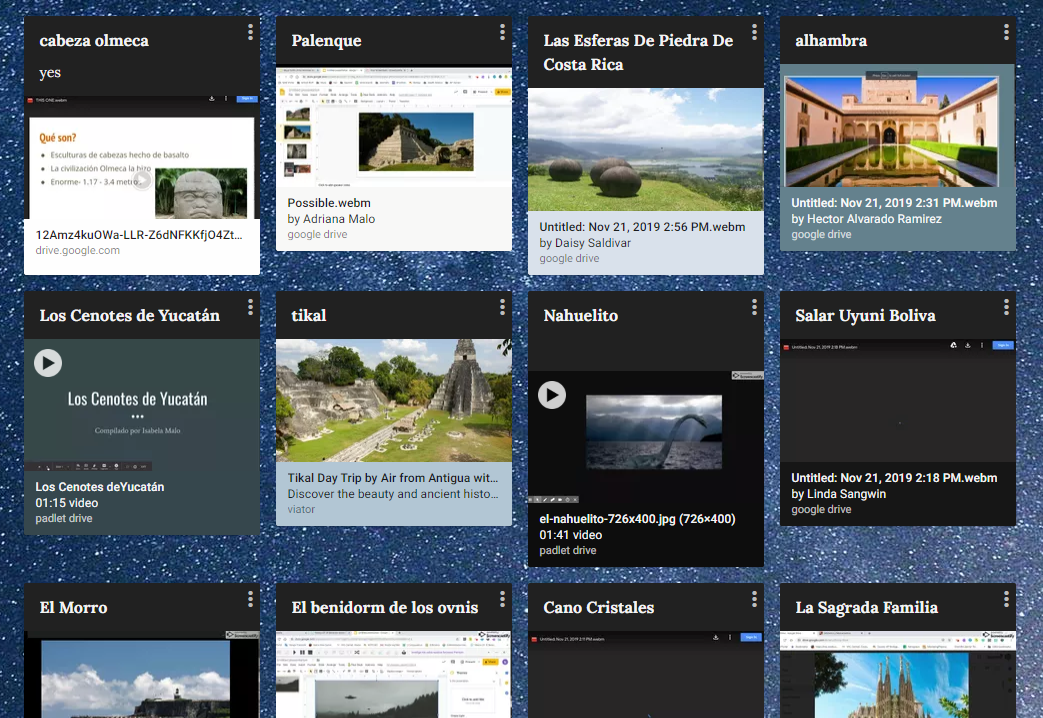
screen grab of Padlet
But more than exposure, Mrs. Cline also wanted her students to create and to have a cross-class collection of student-created resources that they could look back on for this information. That required some creativity on her part. Here is what they did:

Students selected a monument they were interested in and were tasked with creating a screencast about that monument in their target language (Spanish) that both introduced the monument and explained the story behind it. Then, students shared their screencasts on a collaborative Padlet. By having students create screencasts in their target language, Mrs. Cline was able to assess each student’s language learning through an authentic product.

Preview of a Bingo Board created by Mrs. ClineThe next step was to bring the learning together. Through Padlet all students could access and watch each video, but Mrs. Cline motivated them to do so by creating BINGO boards based on the videos students created. Playing BINGO together not only ensured that students would watch the videos, but that students’ had an authentic audience in their peers. Students could also see the relevancy in their purpose for creating -- knowing someone will see your work and find value in it makes learning more meaningful.

Mrs. Cline’s Mysteries and Monument Bingo is a reminder that you don’t have to reinvent the wheel to be innovative, but you do have to push the boundaries of tradition. She started with an established, sound teaching strategy -- she kept the most valuable parts and then skillfully integrated technology to create a deeper and more meaningful learning experience for her students.

Monday, April 8, 2019

How to Turn 6th Graders Into World Travelers


At Gene Pike Middle School, 6th grade World Cultures teachers Connie Garza and Dawn Goldstein want to do more than teach their students about other places -- they want to show their students the world. Consider for a moment that 2018 research discovered 1 in 10 Americans has never left their home state, for financial or other reasons. With this in mind, it's safe to assume not all of our students will have the opportunity to visit many of the far-off places they're learning about in school.

Still, we know that learning to understand other cultures and gaining perspective on how other people live is an important part of succeeding in our global society and in learning to be a well-rounded individual. Thanks to Google’s Virtual Reality (VR) Tour Builder, even if Garza and Goldstein can't fly their students abroad, they can still take them to places all over the world.

For context, Google’s Virtual Reality platform relies on Google Earth’s existing 360-degree footage, making it possible to virtually explore any place in the world through your computer screen or a pair of VR Goggles. What’s even better? Their VR Tour Creator allows people (in this case 6th graders) to design a virtual tour with stops anywhere around the globe and lets them embed their own photos or written details into the tour.

After explaining their task to students, Goldstein and Garza used student-led stations to guide their learning about Europe. During their stations, students used hyper docs and other printed and digital resources to learn about European countries overall, documenting what they learned in their “travel journals” and earning stamps in their “passports” for visiting each country. Throughout this step, students gained important insight into the countries and cultures that would ultimately help them build their tour during work-time.

A key success in this project is that by launching the project before introducing and researching the countries, Garza and Goldstein prolonged their students’ inquiry and created a crucial “need to know”. Instead of learning for the sake of learning (albeit a worthy endeavor), these students were learning with the motivation to design their dream tour through a European country, that would also highlight important geographical and cultural details of each place they visit. This created a personalized passion for their learning that inherently increased student engagement throughout the learning process of every country.

A major challenge in a project like this -- where students are focusing on only one from a list of topics they need to be experts on -- is making sure students master their overall learning about European culture and geography, while still highlighting the country they are most interested in learning more about. To address this, Garza and Goldstein made sure students visited each country through the exploratory stations, but they also gave students a peer audience. Because students would be sharing their projects with each other, they were motivated to do their best work; meanwhile, students were exposed to numerous European countries through their peers' student-created virtual tours.

One thing to remember is that you don’t need VR goggles to make Google’s Tour Builder interactive and exciting. Anyone can explore the tours online, and students can use the “hotspot” feature. For this project, they were asked to add detailed pictures, important travel notes, and fun facts about the culture and geography to make their tours more interactive. For example, one student used a hotspot near Italy’s Leaning Tower of Pisa to clarify that a modest dress code is an important consideration when visiting Italian landmarks. Ultimately, creating tours through Tour Builder is easy, but this "hotspot" feature lets students add reflective depth and learning to their creation. It is a feature that educators can rely on to make the task of creating more rigorous. You can see a student-created tour of Italy here: Example.

Through this project, Garza and Goldstein undoubtedly created a few travel-bugs, but even more, they gave students the opportunity to imagine themselves going on great adventures. They gave this group of sixth graders the chance to be (virtual) world-travelers.

Wednesday, March 21, 2018

The Basics of Blending


In the book, Blended Learning in Action, Catlin Tucker, Tiffany Wycoff, and Jason Green hit the “pulse” of the blended learning movement as they discuss the need for a shift in the way schools “puree” and present content to meet the needs of today’s learners.

They explain this by saying, “We are at the moment in education when our schools can determine if they are Netflix or Blockbuster, Amazon or Borders, Samsung or Blackberry. In each of these cases, the successful organization saw that the entire world was changing and decided they were going to change to be ready for it…shifting vision and culture at the time when it was most critical to their survival.” The point here is that current education models are “crushing” student opportunity by “chopping” key elements needed to engage students and prepare them for “shredding” the future demands of a global marketplace. In an effort to address this need, Northwest ISD has begun piloting blended learning courses where that missing link is helping to fill the gap and expose students to nontraditional forms of instruction by providing learning experiences that aid in better acquisition of future ready skills.

There are common misconceptions about blended learning and what it entails. It is not only integrating technology into the classroom, “flipping” lessons, or even implementing problem based learning strategies. Blended learning includes a “mixture” of those things and more! An article by Michael B. Horn and Heather Staker described blended learning as, “any time a student learns at least in part at a supervised brick-and-mortar location away from home and at least in part through online delivery with some element of student control over time, place, path, and/or pace.” Successfully implementing blended learning requires a complete shift of culture that empowers both teachers and students to be active participants in creating learning opportunities. Horn and Staker explain that making blended learning a reality requires “letting go of the idea that we always have to teach something in order for students to have learned it.” Empowering students by allowing them choice and independence within the pace and structure of the course as well as connecting the traditional, face-to-face learning time with digital learning time is all key to the success of blended learning courses and eventually strengthens student capacity for independent problem solving and critical thinking.

Jennifer Hamzy, a teacher at V.R. Eaton High School, facilitates the current blended AP Psychology course there and she feels that the digital days incorporated into the course create an opportunity for “differentiation and for students to decide what works best for them.” She also appreciates how the blended format puts more responsibility on the students to develop “better study skills” and to “learn how to independently read a college text.” Jennifer frequently encourages collaborative strategies to help guide students on digital days. They are encouraged to utilize Google Suite tools as well as various digital study aids like Quizlet, YouTube videos, and online practice assessments to learn and reinforce concepts on their own while allowing more in person class time for discussion, teacher guidance, and whole group activity. AP Psychology students, Anya and Patricia, stated that they enjoyed having “more time to get work done” independently while also having the option to “meet up to work together” with other students either digitally or in person.


Although blended learning has been largely successful in Mrs. Hamzy’s class and she is extremely well-versed in problem based learning strategies, student goal setting, and differentiation, she feels that she can improve her blended learning course by providing more specific expectations to students early on in order to guide them in productive ways to spend their digital days as well as by incorporating more flipped techniques to help ensure that students have the necessary background knowledge and preparation to complete problem-based tasks and projects. Mrs. Hamzy regularly utilizes Google Suite, Moodle, and other digital resources to engage students with content independently and collaboratively but is constantly making adjustments and trying new tools to help her create additional independent learning opportunities for students. Online resources such as Pear Deck, edpuzzle, FlipGrid, Formative, Screencastify, and even digital badging can all increase student engagement with content while allowing students room to individually and collaboratively remediate, accelerate, or manipulate their own interactions with concepts and skills. Hamzy describes the transition to a blended learning course as “a process” and says that teachers new to it should “give themselves a break the first year” as they take risks with a new role, different strategies, and unfamiliar resources. She says that as you progress, “you discover that some things work and some do not but that’s okay” because you adjust and improve for the next time.

As the availability of blended learning courses to NISD students increase over the next few years, other EHS teachers, like Renata Schlotzhauer and Ashley Harden, will be expanding this course structure to other content areas such as science and World Languages. Mrs. Harden says that she is looking forward to “students growing academically and personally as they are given more responsibility.” She also feels that it will help to deepen student understanding in science because they are allowed to cover more information at a more personalized pace.”
Prior to the course selection process for next year’s classes, both Mrs. Harden and Mrs. Schlotzhauer took time to speak with incoming students about what they could expect and Mrs. Schlotzhauer explained that she felt there were “unlimited possibilities for delivery of content, student collaboration, and exploration of new concepts.” Students will have real opportunities to grow as self-sufficient, critical thinkers as they are forced to begin thinking and working in more organic and experiential ways through these blended classrooms. Tucker, Wycoff, and Green state that, “…it is the advent of modern technology that now makes this type of learning experience possible in every classroom and for every child” and that “the rewards of student learning, engagement, and empowerment will be manifold.”

Monday, October 31, 2016

Triple Threat… Culture, Creativity, and Technology

When you think of a traditional art class in elementary, what comes to mind? Pencil, paper, paint, pottery and maybe a few other ways to create. At Peterson Elementary, Mrs. Mock and Mrs. Ericsson’s 5th grade art classes are taking it up a notch. They are incorporating 21st Century Skills and school culture into Fine Arts Education.  

Making of the movie...ACTION!
After viewing a variety of stop motion animation videos, a technique that makes inanimate objects appear to be moving, the students were given the task to create their own. They were given the prompt “How We Do Things at Peterson” and were able interpret that idea however they saw fit, giving students ownership and choice. Once they were in their groups, students assigned roles and split up tasks.  Being able to develop, implement and communicate new ideas to others effectively is an important skill to learn at this age. Everyone had different ideas on what they thought the video should be about. Presley pointed out, “We had to work together to come up with a plan. We knew we wanted to make sure that we represented what we do here at Peterson, so something that is really big here is our assemblies.”

Once the plan was in place, the groups created comic strips of the story they wanted to tell in the stop motion video. Mrs. Mock and Mrs. Ericsson gave them all different types of materials to to choose from for the creation of the background scene and characters.

Now it was time for the making of the movie! Students took images of their characters, moved the objects frame by frame, and created an illusion of movement in the iMotion app on the iPad. For many of the students, it was their first trying stop motion animation, and they were surprised how easy it was to create. Some groups wanted to take their movie up a level and add sound. They decided to smash the app Shadow Puppet Edu to voice over their video. Sydney commented, “Adding the second app was fun, it made our video more exciting and we were able to tell our story better.”

Mrs. Mock and Mrs. Ericsson found a way for 21st Century Learners to explore creativity, find the value of the importance of school culture, and actively use technology in the Fine Arts classroom.