Showing posts with label World Language. Show all posts

Tuesday, February 11, 2020

Monuments & Mysteries: An Innovative Jigsaw In Language Education


At Northwest High School, AP Spanish teacher Ginger Cline is doing more than teaching a language. She works hard to truly connect her students to the cultures of the people who speak the target language -- that takes intentionality and innovation. Fortunately for her students, she is committed to both.

In addition to language, culture can be found in the stories told and monuments recognized. Whether a globally-celebrated landmark or simply a local treasure, monuments hold meaning, and by learning about them we can learn more about the culture and ideas that they represent. That said, it would be impossible to teach every student about every meaningful monument across Spanish-speaking cultures. That’s why for this assignment Mrs. Cline put a few engaging twists on a tried and true method -- the jigsaw method.

The traditional jigsaw method works like a puzzle. First, students take on the role of investigator and teacher; they work in small groups to understand and become experts on a part of the overall collection of information before then teaching their small part to their peers. Even though students are initially only responsible for learning and teaching one part, through the presentations at the end, all students have the exposure to and opportunity to learn all of the material. Because students have become experts on part of the information with the purpose of teaching others, this process gives students ownership in their learning.
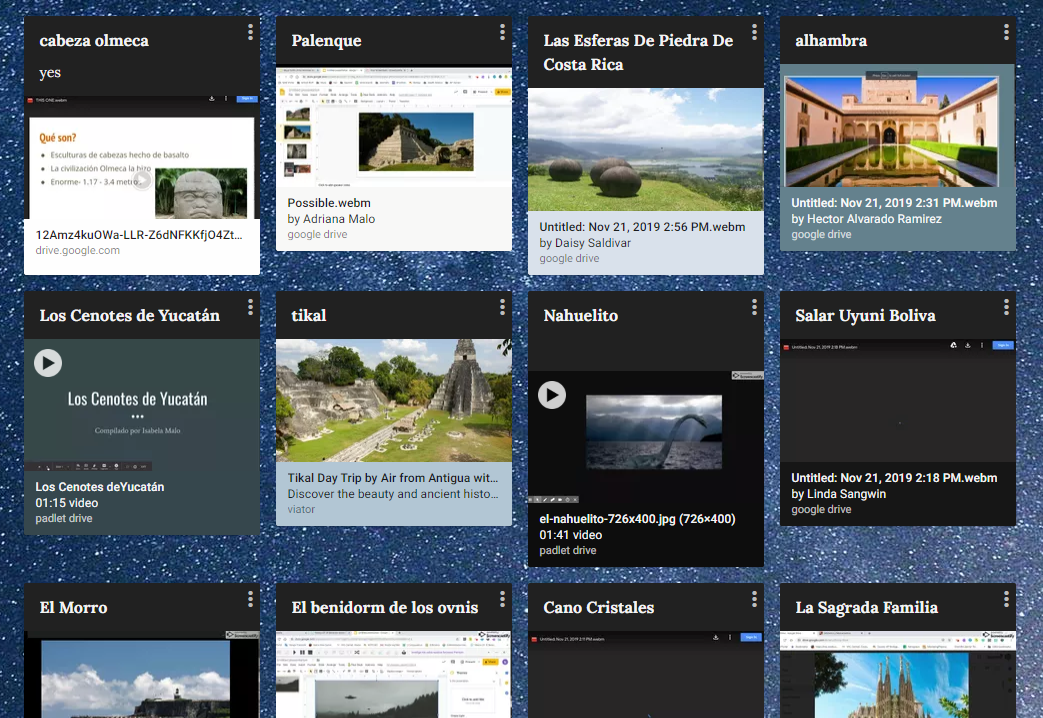
screen grab of Padlet
But more than exposure, Mrs. Cline also wanted her students to create and to have a cross-class collection of student-created resources that they could look back on for this information. That required some creativity on her part. Here is what they did:

Students selected a monument they were interested in and were tasked with creating a screencast about that monument in their target language (Spanish) that both introduced the monument and explained the story behind it. Then, students shared their screencasts on a collaborative Padlet. By having students create screencasts in their target language, Mrs. Cline was able to assess each student’s language learning through an authentic product.

Preview of a Bingo Board created by Mrs. ClineThe next step was to bring the learning together. Through Padlet all students could access and watch each video, but Mrs. Cline motivated them to do so by creating BINGO boards based on the videos students created. Playing BINGO together not only ensured that students would watch the videos, but that students’ had an authentic audience in their peers. Students could also see the relevancy in their purpose for creating -- knowing someone will see your work and find value in it makes learning more meaningful.

Mrs. Cline’s Mysteries and Monument Bingo is a reminder that you don’t have to reinvent the wheel to be innovative, but you do have to push the boundaries of tradition. She started with an established, sound teaching strategy -- she kept the most valuable parts and then skillfully integrated technology to create a deeper and more meaningful learning experience for her students.

Monday, February 4, 2019

"Hear" Me Out: Deaf Culture Experience/Experiment

Challenge: You are about to experience simulated deafness for a full 24 hour period to truly experience authentic ASL language usage as a hard of hearing individual. 

What a shock that must have been to the students in Mrs. Enfinger's American Sign Language I and II classes as Byron Nelson High School. While this teacher is able to somewhat mimic this experience in class by having full silent class days by which students must solely sign the language without speaking aloud or listening to said communication, this experiment provided a truly different take on removing sound from the equation. As a result of the experiment, deaf culture awareness was at an all time high at BNHS as students, parents, teachers, and administrators were talking about their opinions, accommodations, concerns, and perceptions which brought to light the need for true empathy and understanding for ALL types of students.

To begin, the following various stakeholders were informed about the experience.
  • Students who would be participating learned of their assignment expectations and details
  • Parents of those students in part that the experiment was expected to continue in full effort at home throughout the 24 hour time span
  • Teachers and all other school staff since they would have these ASL students in their classes as well as other staff members who would be witnessing the experiment in other roles
The most frequently asked question was "How am I supposed to teach?" or "How is my student supposed to learn?" The best part about these questions is that the eye-opening learning experiment would not solely be experienced by the direct participant, but so much learning and understanding would also occur with other responsible parties.

To prepare for the "big day," students were tasked with researching ADA (American Deaf Association) requirements or accommodations available for all of the students' traditional daily activities including in the classroom such as enabling closed captioning on videos, live closed captioning on Google Slides, in addition to what needs may result for electives such as music or sports, and even church or other after school activities. They also gained an awareness of additional accommodations to accomplish other things they would want to do such as technology available including phone apps, interpreter and closed captioning services. Furthermore, research continued as students learned about Mandy Harvey and Nyle Dimarco to study deaf later in life vs. deaf from birth. Going into the experiment, students not only had a base understanding of the language they've so far learned through a traditional classroom setting, but they've also had a heightened interest in cultural aspects and legal accommodations as this research was authentic and immediately applied.

Students didn’t know the exact day they would go deaf in order to simulate adult deafness as it is usually gradual and don’t know it is happening. Instead, they showed up to class on a random day and were then told it would be their day to go deaf. The kids wore inner earplugs and outer ear muffs and on a scale of 1 to 10 (1 being profoundly deaf) were a 3-4 to simulate an adult who was hard of hearing. Students had their choice of how they preferred to journal their experience from keeping an ongoing written blog via Google Doc, a vlog (video blog) for extra credit to later by shareable via YouTube, voice notes on a phone, other other digital presentation format.  

Alisa's full YouTube video blog (vlog)

Alisa's thoroughly detailed, insightful blog

Megan & Copelynn's Adobe Spark Page Experience Summary
These examples above show the passion and above-and-beyond-effort these students exhibited through being given an relevant, authentic experience coupled with the ability to share their story with a live, authentic audience. 

Mrs. Enfinger concluded that “The amazing thing about ASL is that I get to watch these kids fall in love with the culture and the people in a different way. They have a deep compassion and admiration for them, but it is difficult to teach them an understanding, empathy if you will. Not sympathy at all because what they learn over everything else is how empowered they felt- truly no fear! This experience was meant to educate them and those around them that the deaf can do anything the hearing can do except hear.”

This experience meets International Society for Technology in Education (ISTE)’s standard of a Knowledge Constructor in which “students plan and employ effective research strategies to locate information and other resources for their intellectual or creative pursuits” (3A) and “students build knowledge by actively exploring real-world issues and problems, developing ideas and theories and pursuing answers and solutions” (3D). 

Monday, November 19, 2018

Say “Oui!” to Performance-based Assessments


If you’re anything like I was as a classroom teacher, you’ve spent many nights drowning in papers to grade. You understand the time spent in coffee shops, trying desperately to get caught up. And yet, if you’re anything like me, there have been times that, after all those hours and lattes, you weren’t satisfied that your students’ grades actually reflected their knowledge and ability. Where was I going wrong?

I assigned and graded vocabulary worksheets each week, but students were still scoring low on their diction in writing. I graded reading quizzes that assessed plot and character knowledge, but in the end some students couldn’t talk about the major themes of a novel. Between what felt like wasted class time and weekends spent grading, it never failed that when it turned out an assignment didn't actually tell me whether or not my students truly “got it”, I was left frustrated.

I understood that traditional assignments and tests work to show if students “know” something, but quickly learned that they fall short as an indicator of whether or not students can actually use that knowledge. Of course there is a time and place for each, but it is important for teachers to challenge their students with performance-based assessments if they want to know that students can apply their knowledge in meaningful ways. Northwest High School’s French teacher, Madame Blanc (Mrs. White), made this shift in her classroom this year, away from traditional tests and towards a performance-based method of assessment -- and it seems to be paying off.

Each six weeks, Madame Blanc gives her students both creative tasks and opportunities to apply and demonstrate their learning through student-created products that are ultimately shared through their ePortfolio, a personal and digital collection of their growth and learning. As a basic example, she asked her students to create an article for a French magazine that explains an American holiday and custom as a way to assess their application of many language skills they are working on.

French student Elise Reuman recounted one assignment where she and her classmates were asked to create a video that described their partner’s family as a way to demonstrate their ability to use adjectives in French. Using Adobe Spark video, she described her classmate's family. Elise reflected, “...using the vocabulary in a way that applied it to a likely scenario really helped to ingrain the information. Projects like this usually only require the [written] portion of the vocabulary… [but] Mrs.White, went a step further and required a vocal response as well. This really solidified some of the pronunciation and helped me become more comfortable with actually speaking the French language.”

As Elise shared, performance-based tasks engage students in more authentic opportunities to practice real-world skills. It’s important to note that, in a performance-based classroom “teachers do not have to “give up” units of study or favorite activities” (ASCD). According to ASCD, it’s because these “authentic tasks are rooted in curriculum” that “teachers can develop [assignments] based on what already works for them.” It’s ultimately through small changes in how teachers ask students to learn that “assignments become more authentic and more meaningful to students.”

For example, in another assignment in Madame Blanc's class, students were challenged to learn about multiple perspectives, including the likes and dislikes of French teenagers. They had to go further to compare/contrast these perspectives with those of American Teens. Students interviewed their peers (some opting to collect data through Google Forms), graphed and visualized the data they collected (through Google Sheets), and then wrote of summary of their findings in both French and English, finally sharing their work through their ePortfolio (a website created on Google Sites). Assignments like this require students to be strong in their content knowledge, but more than that, they develop skills outside of French language studies -- skills like the 6 Cs: creativity, communication, collaboration, critical thinking, character education, and citizenship.

Watching performance-based assessments work for Madame Blanc has reiterated what hindsight and experience taught me: It was when I focused on creating rigorous and authentic learning tasks for my students, rather than assigning simple checks-for-understanding for grades, that I best served them. It is through rigorous, performance-based learning tasks that we can empower our students to think critically and create, and that we can most accurately and authentically assess their learning.

Monday, April 9, 2018

Student Choice & Content Creation - Not So "Foreign" After All!

Learning a foreign language can be, well, foreign sometimes! On top of mastering new vocabulary and verb conjugations, students in Pre-AP Spanish II are also learning the difference between two past tenses, preterite and imperfect, and then identifying the corresponding verb conjugation for that correct past tense - whew! In Spanish, you must differentiate between the two types of past tense shown the below table.


Preterite Tense
Imperfect Tense
Definition
A completed action in the past
Ongoing, repeated, or past actions without implied specific beginning or end
Example
“He put his hand through the car window.”
“The birds sang.”


It’s been said that mastering preterite and imperfect can be done through repetition in that the more you do it, the better you will get at it. While this skill can be sharpened through worksheets or practice sentences, this concept is a difficult one that gets solidified in memory when it is applied. Language is developed through speaking, listening, reading, and writing, so what avenue is best to facilitate this language acquisition?


Asking a high school student to speak in front of their peers is scary enough, add on top of that the factors of the language not being their primary one, compiled with a new and super challenging concept as well as one that requires much thought before the actual sentence is constructed. Listening and reading are both effective in learning the content, but both of these depend on teacher-facilitated content consumption rather than student-driven content creation.  So, two Byron Nelson Pre-AP Spanish teachers, Matt Condon and Isabel Greuling, created the perfect project to get the best mix of language development through product creation with appropriate scaffolds to facilitate student success. Students were tasked with writing their own Spanish Children’s Story Book!


To communicate clear expectations, students received this Rubric, Requirements, and Rough Draft document which contains intentional planning tools such as separate boxes to pre-write two sentences per page, a space to plan vocabulary that will be used and its translation in both English and Spanish, and instructions to highlight verbs and grammar. To facilitate effective story development, students also completed this StoryStarter questionnaire to help students develop the concept prior to developing the language used to describe it. To gain quality peer feedback, students reviewed each other’s rough drafts using this Peer Edit Guiding Questions. Lastly, students constructed their final draft using the online story creator site: Story Jumper; those who are more artistically advanced or who prefer to work offline also had the option to creating a physical book that meets these same requirements.

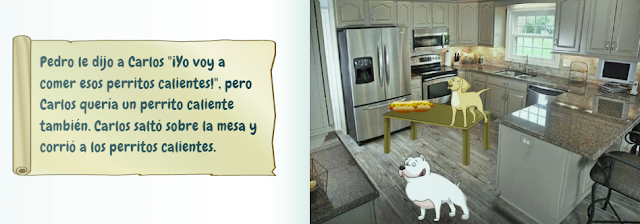
Below are a few exemplars. Click each image to view the full version within Story Jumper.

Teacher Feedback: Jackson did a fantastic job of using the preterite and imperfect correctly throughout his book. This book contained very few errors and had a wide range of varied vocabulary covered in Spanish 1 & 2.  Jackson terrifically demonstrated his knowledge and mastery of grammar and vocabulary concepts from the last few chapters.  

Teacher Feedback: Dylan exceeded the project’s expectations on this activity by creating a funny, original story with a surprise ending and using correct preterite & imperfect usage to narrate the book.

Teacher Feedback: Adriana's story is very original, and she uses multiple concepts we have learned this year very well. 

Additional student exemplars: Samuel el Sapito and La Mofeta Triste


Students were able to extend the project a step further in creating an audio file of them reading aloud their storybook; thus, refining the skill of speaking the language. In doing so, students can practice pronunciation using a familiar text that they personally constructed which again sets the student up for success. This optional additional audio file can be embedded on the first page of each Story Jumper book.


“I don’t teach a foreign language, so how can this concept be applied to my classroom?”

This project has multiple elements of "good teaching" that can be applied to all ages and content areas.

Highest level of Bloom’s = Creation
  • Are you providing time for your students to apply their learning to their own student-driven product?
Student Choice
  • Students were able to choose their own setting, characters, and script providing multiple opportunities for student buy-in and student-selected opportunities to demonstrate success.
Scaffolding
  • Appropriate planning documents and class time were provided to allow students to pre-write and get peer-feedback for revising and editing.
Cross-curricular
  • Since Spanish is a language, incorporating ELA elements lend itself easily to this task. Rather than simply saying “Write using appropriate grammar,” this project reminded students of multiple literary elements such as setting, character development, and climax which are concepts currently being studied in English I-IV.


This activity meets ISTE's Student Standard of being a 'Creative Communicator' in which "Students communicate complex ideas clearly and effectively by creating or using a variety of digital objects such as visualizations, models or simulations.." (6c)