Showing posts with label Math Workshop. Show all posts

Tuesday, January 22, 2019

"R"edefining Review


"R"edefining Review
          
          When creating another semester exam review seems like a daunting task, why not flip the script and allow for creativity and innovation to take over.  At least that is what Mrs. Ashley Anthony decided to try in her class at the end of the Fall Semester.  "I just want to try something different for this time around," Mrs. Anthony explained.  "My goal is to challenge my students to think out of the box to create a resource for all of my other students to be able to use to study for their semester exam."  Naturally, she knew that if students could explain a concept thoroughly, they had a true and deep level of understanding for that topic.

          Collaboration and communication were instrumental at getting this project off the ground.  From its inception, Mrs. Anthony knew that she wanted this project to be completely student-driven, even from the very beginning.  Any teacher would simply give their students a project description and a rubric to follow.  However, as an exemplary teacher, Mrs. Anthony had her students define the rubric themselves, rooting this project in a rich research-based best practice.  Giving them the basic expectations in the middle column of the rubric, students then were tasked, through small-group and whole-group discussion, to create their own exemplary and needs-improvement criteria to demonstrate success.          


          The time came for the students to begin creating their collaborative Google Site.  Students partnered together and self-selected the math topic that they felt most comfortable with explaining.  The directions were clear.  Keeping in mind the Math Workshop Model, students had to create a lesson that taught the concept in an opening, ask higher-level questions through a work period, and finally allow for students to reflect on what they learned through a student-created formative assessment.  The only parameters students were given were the project description and the rubric they created.  Then they were off.  Immediately there was a buzz about the classroom about which platform to use.  Rylan suggested, "We should make a self-paced Peardeck presentation because it is interactive, so students will be engaged, and they can continually review their work."  Kate's enthusiasm with embedding a Google Site in the review site was exemplified when she said, "This is the best way we thought to organize our topic of ordering fractions, decimals, and percentages."  Will quickly got busy combing videos into WeVideo to teach his topic.  He shared, "I loved this project so much because we each got to find our own way of sharing our learning through teaching others."  Other preferred methods of delivery were Google Slides, Powtoon, and Google Docs.


          The aspect of this project that stands out most is that Mrs. Anthony knew what her students were capable of and knew that she needed to differentiate for this class.  In having her students create this resource for all of the other students at Chisholm Trail Middle School, she exemplified the "R" in the SAMR model.  SAMR is an acronym standing for Substitution, Augmentation, Modification, and Redefinition.  This model is a way for educators to assess how effectively they are using technology in their classroom.  Redefinition is in the transformation range, and it is quite clear that this entire project, from beginning to end, screams just that.  A transformation of a tried and true method of reviewing for a semester exam to one that is student-led, student-created, and serves as a method of instruction that reaches beyond their own classroom.  When asking Mrs. Anthony what her thoughts were on the entire process, she said, "I can't believe that it has taken me this long to try this with my students.  Every class is different and you have to know what they are capable of, but when you let them take the lead, they can produce great things.  This entire project seemed to transform the process of review and was an exciting way to do it."

Check out the 6th-Grade Compacted Math student-led semester review from Chisholm Trail Middle School by clicking the link below.

Sunday, March 19, 2017

Students Teaching Students

According to instructional technology Guru Alice Keeler, "The person doing the work is the person doing the learning." At the end of the day, are you tired or are your students?  Yari Kemp, math teacher at Chisholm Trail Middle School, makes sure she sends her kids home each day exhausted from learning!  As a math teacher, Mrs. Kemp works tirelessly to provide students opportunities to think deeply and reflect on their learning.  Recently, students and teacher traded roles when students were asked to create “How-To” style tutorials teaching a classmate about Volume.

7th grade PreAP and 8th grade On-Level classes studied Volume for several weeks.  At the conclusion of the unit, students were challenged with the task of utilizing a digital tool to create a tutorial for classmates still struggling with the topic.  Students could choose from Canva, Google Draw, WeVideo, Adobe Spark, or Piktochart to complete the assignment.  Since students were encouraged to select their own tool, this project allowed for limitless creativity, evident in the completed products.  Take a look at a few examples below.


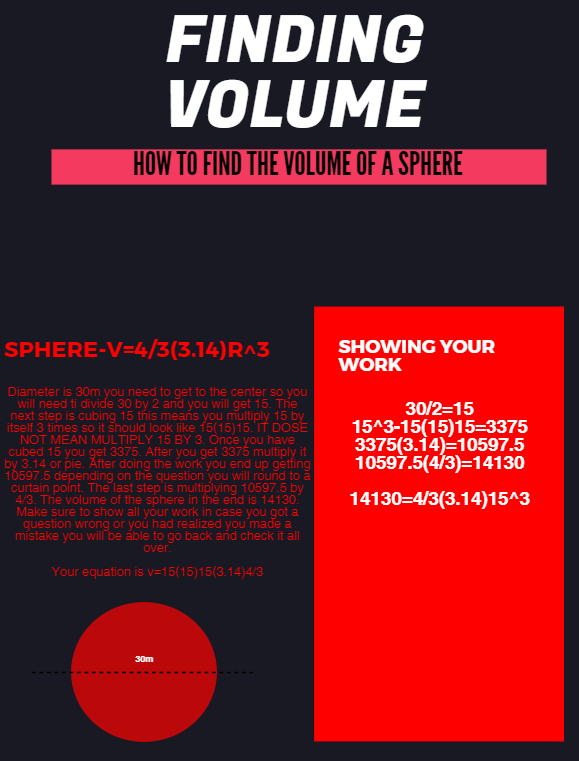
Kasey, an 8th grade student in Mrs. Kemp’s class, transferred to CTMS from another district and says he is enjoying math so much more.  He shared he loves the technology integration and working on his Chromebook in math helps keep him engaged.  Kasey used Piktochart to create the tutorial anchor chart shown below.


In this activity, students were empowered by the opportunity to be instructional leaders to their fellow classmates.  According to the ISTE standards, 21st Century learners should “contribute to the learning of others.”  In this powerful classroom example, Mrs. Kemp’s students learned a valuable lesson in communication, collaboration, and supporting others.  

Monday, December 1, 2014

Transformations ARE NOT LOST in Translation in Math


What do careers such as engineering/construction and interior design/decorating have in common? They ALL need to understand relationships between objects.  One might ask HOW do we learn about those relationships like symmetry and similarity?  The answer is transformations. 

Students were challenged with the task to show what they learned about:  reflection, rotation, translation, and dilation using digital tools of their choice.  


Justice explains, "When a translation takes place, the figure is moved, but the shape and size stay the same." https://www.smore.com/tndnd

6-8, Math, Graphing, Digital Design, Smore, Middle School, Wilson Middle School, Math Workshop, Secondary, STEM, Student Voice, TechnoExpo,

Aiyana represents reflection by  "across the y-axis it will cause the y-value to change while the x-value remains the same. it can be represented as (x,-y)." 
https://www.smore.com/q5j97 


Aaliyah analyzes the concept of rotation of the triangle by 90 degrees clockwise around the origin (0,0).  She then states the result as, "My ordered pairs changed from (X, Y) to (-Y, X)" 
https://www.smore.com/dx8sg-graphing-transformation-project 


When we work with shapes and figures it is easy to start to see patterns that designers use to create the final product. Even in a simplistic way the floors of a skyscraper may just be transformations of a different floor with the exact same layout. Figuring out the way those figures need to be moved to optimize the space is really what transformations can teach us.

Colbie noted that because the shapes are congruent in size an architect or interior designer might use this concept to duplicate a part of a room or building. Some buildings have cool features that are repeated to make the building unique. Those features are just transformed from one location to the next.

Olivia saw that with dilations the shape doesn’t stay the same size. “Perhaps a customer likes the design they were given but want it to be larger or smaller like a dilation.”

These projects were created in 8th grade math at Wilson Middle School and exceeded Mrs. Holly Lewis' expectations of creativity, organization, and concept.