
Showing posts with label Advanced Academics. Show all posts

Monday, November 12, 2018

Juxtaposing Student Voice & Choice w/ AP Exam Test Prep

When your Senior level AP course doesn’t have TEKS and is primarily focused on preparing for the AP exam, there is not much room for student creation and choice, right? WRONG! AP English IV (AP Literature and Composition) teachers Denise Tennison and Brittany Harper at Byron Nelson High School look for innovative ways to prepare the student, while engaging them in the learning that goes beyond traditional test prep. What better way for students to learn question analysis than to create AP-level questions themselves. Futhermore, they stepped into the teacher role and used formative assessment websites, like Quizizz, Socrative, and Mentimeter, to create student-made quizzes with a future audience of their own peers. Talk about real world application, authentic audience, collaboration, and student choice - all wrapped up into one!


This task’s purpose was multifaceted as it aimed to 1. Analyze Othello, and 2. Apply knowledge and syntax of the 12 English Literature and Composition Question Types. Specifically, it challenged students to CONSTRUCT AP questions in order to be more prepared to DECONSTRUCT them on the exam as it will be easier to answer high-level questions if students have an understanding of how they are originally developed.  


Project Instructions:


In the past, this project stopped at Step #4 above in which the student solely created the questions on a collaborative Google Doc. Although these did provide a sample set of study questions, they weren’t interactive, thus many peers read over them without truly applying their thinking to answer and engage with the content. Furthermore, there wasn’t an authentic audience since it was simply a paper turned in to be graded by the teacher. To provide a more engaging experience and incorporate student choice, Tennison and Harper brainstormed applicable product choice websites using the Tools that Make IT Click resource to identify a set of options that would work well for this assignment.


Benefits of designing student choice lessons with multiple tool options:
  • Students have power over the tool they chose.
  • They are more engaged in the process because they were able to break out of the “one-size-fits-all” approach in which every students' experience is identical.
  • Students can apply prior experience with tools they have used in other classes to understand which tool most appropriately applies to their content.
  • Neither the teacher or students need to be “tool-expert.” There are so many resources that are Google-able to understand how a tool works; plus, students typically are able to figure site features out quicker than many adults.
  • If a tool doesn’t fit one groups’ needs or isn’t as easy to understand, just pick another platform!


Example #1:
Students: Cavnar, Dumble, Felten, Pham, Cobb, Hinshaw
Formative Assessment Tool: Socrative
Play along HERE! Room Name: CAVNAR


Example #2:
Students: Edwards, Ye, Holt, Plocek, Mauer, Young
Formative Assessment Tool: Quizizz


Students’ feedback on this project was very positive. Because of the collaborative group nature, these teachers overheard really good conversations taking place as students discussed Othello, compared the 12 question types to best assign various formats to their content, and wrote a challenging question and designed relevant distractors. When it came time to enter these into the formative assessment site, students were able to collaborate in discussing their prior experience with various sites as they weighed the benefits and downfalls of each in order to connect the best type of tool to their content needs. Additionally, they were able to design the type of experience they would most like to participate in such as choosing sites that use gamification, whole class/group vs. individual quizzes, and embedded opportunities for detailed student feedback. The final products will support students two-fold: allowing the student to be the “teacher” in designing the content, as well as letting the student be another peer's student by taking each other’s assessment’s now and in the Spring to prepare for the exam. Adios traditional, boring test prep!

Monday, April 9, 2018

Student Choice & Content Creation - Not So "Foreign" After All!

Learning a foreign language can be, well, foreign sometimes! On top of mastering new vocabulary and verb conjugations, students in Pre-AP Spanish II are also learning the difference between two past tenses, preterite and imperfect, and then identifying the corresponding verb conjugation for that correct past tense - whew! In Spanish, you must differentiate between the two types of past tense shown the below table.


Preterite Tense
Imperfect Tense
Definition
A completed action in the past
Ongoing, repeated, or past actions without implied specific beginning or end
Example
“He put his hand through the car window.”
“The birds sang.”


It’s been said that mastering preterite and imperfect can be done through repetition in that the more you do it, the better you will get at it. While this skill can be sharpened through worksheets or practice sentences, this concept is a difficult one that gets solidified in memory when it is applied. Language is developed through speaking, listening, reading, and writing, so what avenue is best to facilitate this language acquisition?


Asking a high school student to speak in front of their peers is scary enough, add on top of that the factors of the language not being their primary one, compiled with a new and super challenging concept as well as one that requires much thought before the actual sentence is constructed. Listening and reading are both effective in learning the content, but both of these depend on teacher-facilitated content consumption rather than student-driven content creation.  So, two Byron Nelson Pre-AP Spanish teachers, Matt Condon and Isabel Greuling, created the perfect project to get the best mix of language development through product creation with appropriate scaffolds to facilitate student success. Students were tasked with writing their own Spanish Children’s Story Book!


To communicate clear expectations, students received this Rubric, Requirements, and Rough Draft document which contains intentional planning tools such as separate boxes to pre-write two sentences per page, a space to plan vocabulary that will be used and its translation in both English and Spanish, and instructions to highlight verbs and grammar. To facilitate effective story development, students also completed this StoryStarter questionnaire to help students develop the concept prior to developing the language used to describe it. To gain quality peer feedback, students reviewed each other’s rough drafts using this Peer Edit Guiding Questions. Lastly, students constructed their final draft using the online story creator site: Story Jumper; those who are more artistically advanced or who prefer to work offline also had the option to creating a physical book that meets these same requirements.

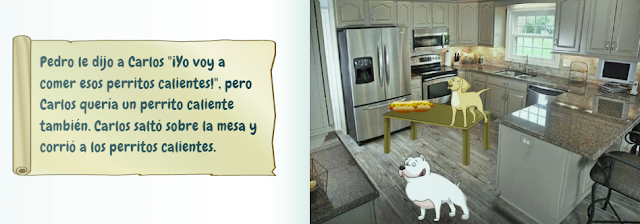
Below are a few exemplars. Click each image to view the full version within Story Jumper.

Teacher Feedback: Jackson did a fantastic job of using the preterite and imperfect correctly throughout his book. This book contained very few errors and had a wide range of varied vocabulary covered in Spanish 1 & 2.  Jackson terrifically demonstrated his knowledge and mastery of grammar and vocabulary concepts from the last few chapters.  

Teacher Feedback: Dylan exceeded the project’s expectations on this activity by creating a funny, original story with a surprise ending and using correct preterite & imperfect usage to narrate the book.

Teacher Feedback: Adriana's story is very original, and she uses multiple concepts we have learned this year very well. 

Additional student exemplars: Samuel el Sapito and La Mofeta Triste


Students were able to extend the project a step further in creating an audio file of them reading aloud their storybook; thus, refining the skill of speaking the language. In doing so, students can practice pronunciation using a familiar text that they personally constructed which again sets the student up for success. This optional additional audio file can be embedded on the first page of each Story Jumper book.


“I don’t teach a foreign language, so how can this concept be applied to my classroom?”

This project has multiple elements of "good teaching" that can be applied to all ages and content areas.

Highest level of Bloom’s = Creation
  • Are you providing time for your students to apply their learning to their own student-driven product?
Student Choice
  • Students were able to choose their own setting, characters, and script providing multiple opportunities for student buy-in and student-selected opportunities to demonstrate success.
Scaffolding
  • Appropriate planning documents and class time were provided to allow students to pre-write and get peer-feedback for revising and editing.
Cross-curricular
  • Since Spanish is a language, incorporating ELA elements lend itself easily to this task. Rather than simply saying “Write using appropriate grammar,” this project reminded students of multiple literary elements such as setting, character development, and climax which are concepts currently being studied in English I-IV.


This activity meets ISTE's Student Standard of being a 'Creative Communicator' in which "Students communicate complex ideas clearly and effectively by creating or using a variety of digital objects such as visualizations, models or simulations.." (6c)

Wednesday, November 1, 2017

Advancing Academics: More than Test Prep

As educators focus on growing their Advanced Academics programs and improving AP test scores, too often their conversations begin and end somewhere around “test prep”. While there is value in traditional test prep strategies like multiple choice practice and repetitive text analysis, students also desperately need to be able to think critically and apply their knowledge in meaningful ways.
Northwest High School’s AP World History teachers, Jeanette Jones and Nicole Olson challenged their students to collaboratively depict the effects of historic trade routes based on the five major themes of their AP course. Student Sam clarified, “We were given a map of all of the trade routes …and had to accurately describe the interactions between those empires on an environmental, economic, social, political, and cultural level.” Students worked together to research and create an infographic that compares trade routes and visualizes key points of their research. (You can access the full instructions here.)

Students were given choice in how to create their graphics; however, Jones & Olson specified that students couldn’t use PowerPoint or Slides to create their presentations because while useful, these platforms are too visually limiting for the needs of this assignment. Instead, they recommended Piktochart, a platform designed for creating professional presentations and graphics. (Check out these student examples: Sample: Smore & Sample: Piktochart.)


Student Bailey reflected on how this task prepared her for the AP exam, saying, “Trade routes are a major part of how things got diffused in the world… how language got diffused and cultural trade… those are important things to know for the AP exam because they are such a huge part of history.” She added, “And when I make a presentation for something, I typically try to make myself an expert in it…”

Creating infographics as a way to present research and demonstrate understanding of content engages students in a hands-on, student-centered learning process. Sam points out that, “When [you] read a textbook, you’re just looking for answers to the reading guide or for vocabulary. Having to do a project, to write it down and describe it, you really think about what you’re doing and how you’re learning it”. When students engage in collaborative tasks that require in-depth analysis and critical thinking, they gain sincere ownership of their learning that results in a lasting understanding of content in ways traditional test prep alone cannot provide.