Showing posts with label Student Choice. Show all posts
Showing posts with label Student Choice. Show all posts
Tuesday, December 12, 2023

Monday, November 29, 2021
Mad Libs: A Super Silly Way to Fill in the _____________!
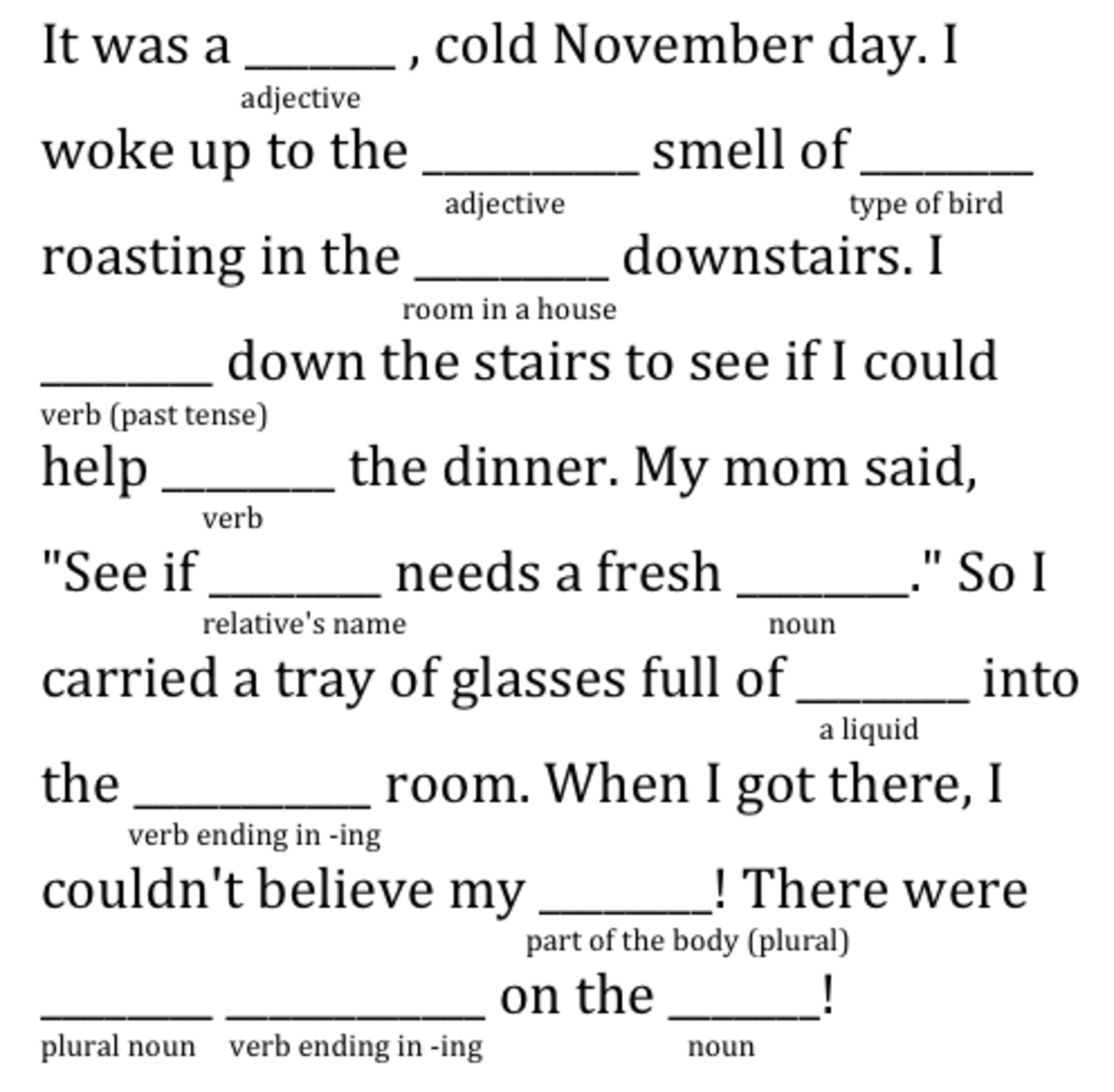
Raise your hand if your childhood memories include completing a couple of pages out of your newest Mad Libs book?! This popular game debuted in 1958 as interactive short stories, where those reading the short stories were prompted to fill in the blank for words that had been omitted. The missing words or phrases would be assigned a specific category or part of speech, such as noun, verb, place, exclamation, and so on. Upon completion, the story would be read aloud. Usually, the story would end up being quite funny and somewhat nonsensical. Countless hours of entertainment were sure to be had.
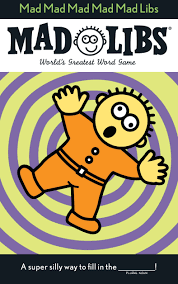
Mrs. Pickett at Beck Elementary introduced her fourth-grade GATES students to this familiar favorite. It didn’t take long for them to catch on and they looked forward to completing new ones during their class visits. Of course, Mrs. Pickett knew these Mad Libs would be entertaining, however, she also knew how they could help reinforce very important grammar skills and challenge their thinking. To successfully complete Mad Libs students needed a clear understanding and working knowledge of the different parts of speech, or their finished story would not make sense.
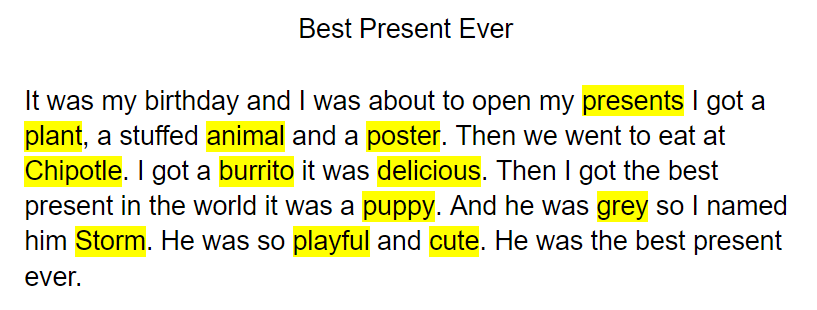
The real challenge came when students were asked to compose their own Mad Libs. They begin with writing short stories about a topic of their choosing. They made sure their story had a clear beginning, middle, and end. When students struggled with coming up with a topic, they were encouraged to write about their favorite candy or something they ate for breakfast that morning. When writing Mad Libs, literally, anything goes!
Once students completed their short story draft, it was time to reread and decide which variables to remove. The variables would be the missing words in their Mad Libs. Because their stories were drafted in Google Docs, students highlighted the variables and identified the part of speech. Careful thought went into selecting which words would be the best variables. Students had to think through scenarios that would result in the most effective, and often humorous, outcome. After all, the fun part of Mad Libs is reading the finished story.
Using Flippity.net, students were then able to digitally publish their short stories in a Mad Libs template. Through using this templated Google Sheet, students became more versed in working in Sheets. They became familiar with the terminology used in spreadsheets, such as rows, columns, and formatting. Once the template was finalized, students published their Google Sheet to the web for sharing purposes. Since most 2nd - 5th-grade students are consistently spiraling back through grammar skills, it was a goal for completed Mad Libs to be shared with the campus.
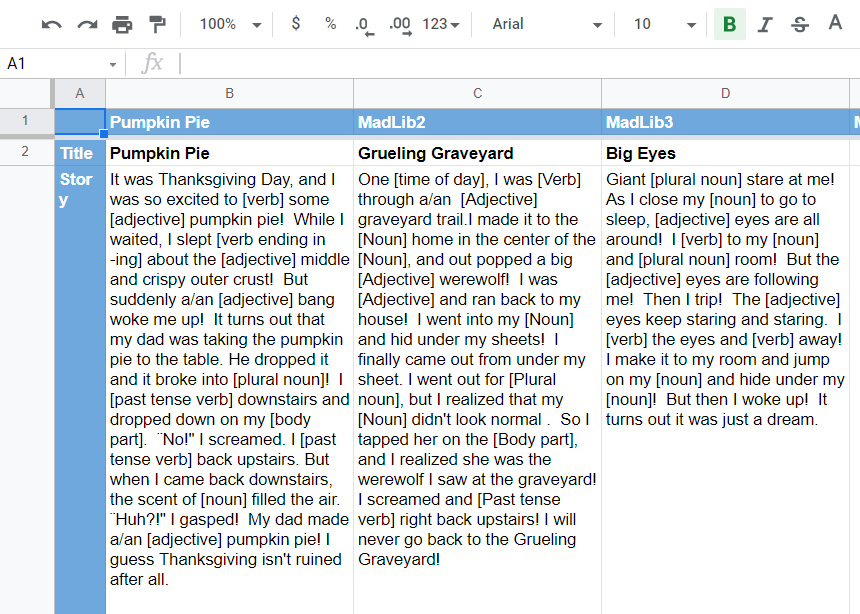
Knowing these completed Mad Libs would be shared campus-wide was motivating for students. They were careful to spend quality time revising and editing their work because their audience was authentic and they wanted to share with pride. Revisions were made again and again as careful thought was given to the various possibilities of responses the Mad Libs may receive. They wanted to make sure the variables were descriptive and specific enough to produce an end product that would
To say these students were engaged in this work would be an understatement. Mrs. Picket said it was incredible to see her students collaborating with one another as they thought critically about the decisions they made to produce their Mad Libs. Students were bonding and building relationships through the process too. The laughter was an added bonus. Countless giggles were shared as students read aloud completed Mad Libs and shared their work with families via Seesaw. This provided them with extra practice with fluency and reading with expression.
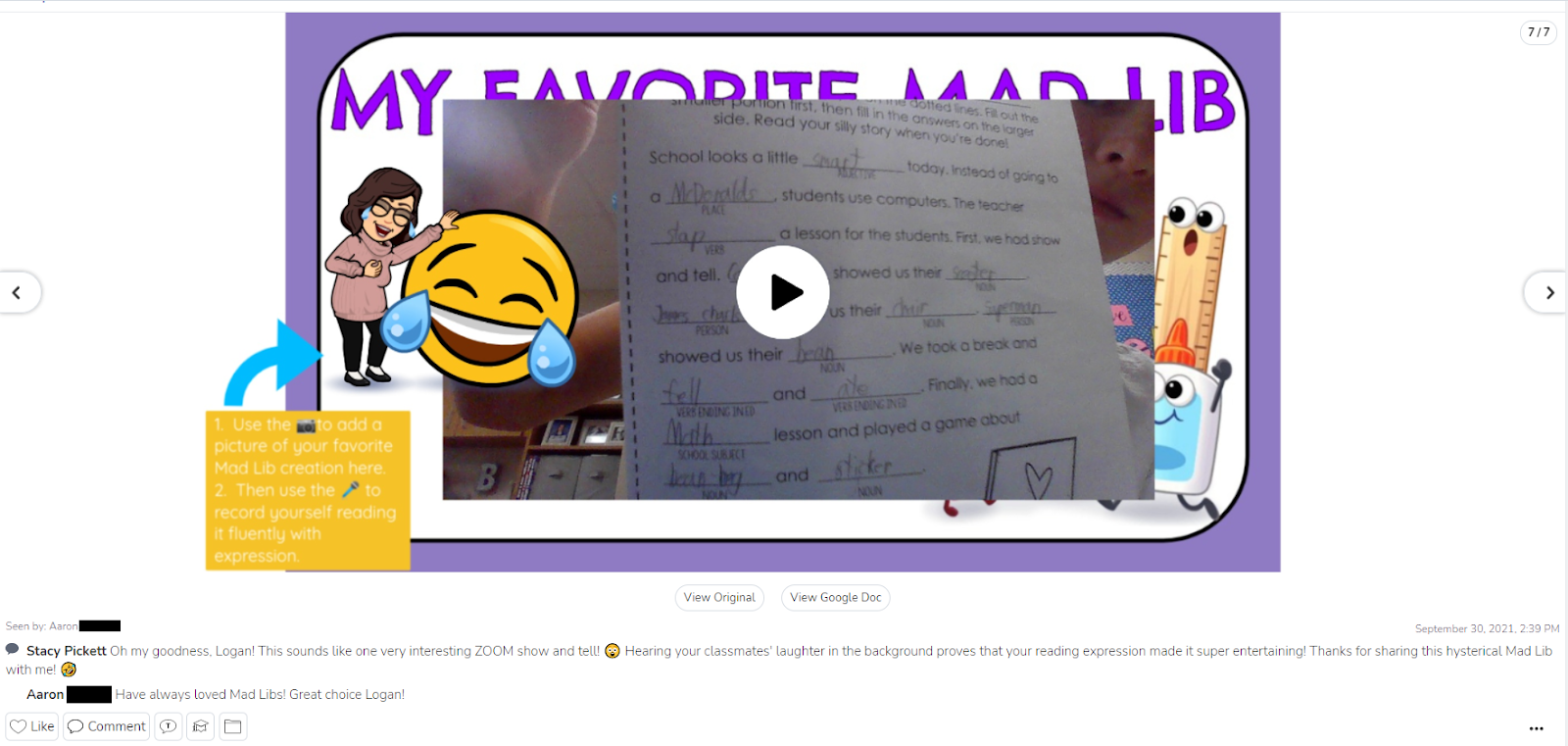
We invite you to explore the Mad Libs created by the 4th grade GATES students at Beck Elementary. Share the Google Slides via Google Classroom or Seesaw. Then we’d love to hear from you. Share out on Twitter tagging @beckelem, @BES_GATES, and @kel_sanders. We can’t wait to share with these students how their work has reached others.


Shout out to Mrs. Dixon's class for diving into these student-created Mad Libs before the break.
Monday, January 27, 2020
A “Different” Approach to “Leaving No Student Behind”
Educators are always looking for new ways to reach students and help them find methods or paths for acquiring success in the classroom. However, it seems that there are some students who, despite our best efforts (and their own), struggle with the institutional process of acquiring knowledge and skills necessary to meet traditional measures of success. After recently reading the words of Katie Usher, a Texas elementary school teacher, it became clear that well-known classroom differentiation practices, although very effective and successful for some, may not be enough for students who need a completely different learning environment in order to access the content needed for mastery. Although Katie’s experiences are based on a gifted classroom, her words are important for all students. She asserts that “In the digital era, we can provide all of our students with technological ways to enhance their learning, no matter their academic label. Every student is different and needs to be offered a variety of ways to show what they’ve learned in a way that reflects their individuality.” This is exactly the philosophy behind the ever growing "Eagle Strong" cycle recovery program offered at Eaton High School (EHS).
 Alicia Dunson, a Professional Communication teacher at Eaton, has spent a majority of her career working to find ways to reach students where they are and to help them progress and find methods for success that work for them. Alicia starts by learning about her students and building relationships with them that allow her to not only ask her students some tough questions about previous academic patterns but she is also able to use her positive relationships to push these students to develop levels of accountability and self-sufficiency that gives them ownership in their own learning moving forward. This philosophy of teaching made Alicia a perfect fit to help develop the "Eagle Strong" cycle recovery program at EHS and to begin working with students to access systems and methods more appropriate for their individual learning needs.
In this program, students are identified as needing intervention before completely failing a course and they are not only given an opportunity to access narrowed and unmastered course content through a self-paced online platform, but they also have the support of certified educators working on campus that can assist as needed. Mrs. Dunson facilitates student progress by helping them learn ways to record and track their own mastery of coursework that work for them and by connecting students with teachers and tutors before, during, and after school hours. Through use of these online tools and content, qualifying students can showcase existing knowledge that might previously have been a struggle for them to display and to do so in a timely fashion without getting behind in credits and while receiving both built-in and in-person remediation. The ability to digitally self-accelerate beyond concepts already mastered and to slow down to focus on more difficult areas of the curriculum make this educational experience unique and more effective for some than a traditional environment.
One student in Mrs. Dunson’s "Eagle Strong" program credits this experience with helping her to revisit and master content from multiple courses without the stress and pressure she typically experiences in a regular classroom environment. She feels that the ability to move through material at her own pace puts the responsibility on her and she says that “You have to learn. You cannot just zone out or not pay attention. It’s all on you.” Another student said that she has learned study skills that can help her in other courses and she feels the online coursework helps her because the courses “have a different way of teaching and gives students different ways to learn the material.” She likes the ability to watch and re-watch a lot of videos that show her examples and also enjoys the freedom to go through curriculum on her own.

While many students thrive in a traditional school environment, some need more than tradition can offer or they may have experienced circumstances that hinder their progress in all or parts of a particular course. In some situations, students simply need other ways to access content in order to master the skills and knowledge necessary to grow and thrive. EHS is providing a method for students to do just that through the development of their cycle recovery program and they are creating options for students to learn and excel that allow flexibility and choice while not compromising student time, interests, and most importantly, confidence. This program, in essence, is an example of differentiation at its best and as our fellow Texas educator, Katie Usher, put it, “Differentiating allows students to have their voice heard, which can lead them to become self-motivated learners. And that in turn can help increase both their learning growth and their self-awareness of that growth.” These achievements in differentiation are much needed components of our educational system that truly provide for a future where fewer students are “left behind.”
Usher, Katie. “Differentiating by Offering Choices.” Edutopia, George Lucas Educational Foundation, 10 Apr. 2019, www.edutopia.org/article/differentiating-offering-choices.

In this program, students are identified as needing intervention before completely failing a course and they are not only given an opportunity to access narrowed and unmastered course content through a self-paced online platform, but they also have the support of certified educators working on campus that can assist as needed. Mrs. Dunson facilitates student progress by helping them learn ways to record and track their own mastery of coursework that work for them and by connecting students with teachers and tutors before, during, and after school hours. Through use of these online tools and content, qualifying students can showcase existing knowledge that might previously have been a struggle for them to display and to do so in a timely fashion without getting behind in credits and while receiving both built-in and in-person remediation. The ability to digitally self-accelerate beyond concepts already mastered and to slow down to focus on more difficult areas of the curriculum make this educational experience unique and more effective for some than a traditional environment.
One student in Mrs. Dunson’s "Eagle Strong" program credits this experience with helping her to revisit and master content from multiple courses without the stress and pressure she typically experiences in a regular classroom environment. She feels that the ability to move through material at her own pace puts the responsibility on her and she says that “You have to learn. You cannot just zone out or not pay attention. It’s all on you.” Another student said that she has learned study skills that can help her in other courses and she feels the online coursework helps her because the courses “have a different way of teaching and gives students different ways to learn the material.” She likes the ability to watch and re-watch a lot of videos that show her examples and also enjoys the freedom to go through curriculum on her own.

While many students thrive in a traditional school environment, some need more than tradition can offer or they may have experienced circumstances that hinder their progress in all or parts of a particular course. In some situations, students simply need other ways to access content in order to master the skills and knowledge necessary to grow and thrive. EHS is providing a method for students to do just that through the development of their cycle recovery program and they are creating options for students to learn and excel that allow flexibility and choice while not compromising student time, interests, and most importantly, confidence. This program, in essence, is an example of differentiation at its best and as our fellow Texas educator, Katie Usher, put it, “Differentiating allows students to have their voice heard, which can lead them to become self-motivated learners. And that in turn can help increase both their learning growth and their self-awareness of that growth.” These achievements in differentiation are much needed components of our educational system that truly provide for a future where fewer students are “left behind.”
Usher, Katie. “Differentiating by Offering Choices.” Edutopia, George Lucas Educational Foundation, 10 Apr. 2019, www.edutopia.org/article/differentiating-offering-choices.
Monday, January 13, 2020
Personalized and Self-Paced Learning for Educators and Students
Classrooms looks different today than they did years ago. We've evolved from a traditional classroom setting where the teacher is lecturing, to a classroom that is active, innovative, and the students are driving the learning. As an Instructional Technologist, I have been fortunate enough to see many different ways educators approach teaching and learning--from the traditional learning model to some of the most innovative and creative classrooms. To create an innovative, open, and creative place for students and teachers to grow, take risks, and feel comfortable in their own patterns of learning three educators have raised the bar to provide those experiences. This past fall semester, Mrs. Roberts, Mrs. Seale (CTE Teachers), and Mrs. Toht (Science Coach for NISD) reached out to their campus Instructional Technologist, Rene' Egle, to brainstorm ideas of ways to raise the level of learning for students and teachers by integrating technology.
The College and Career Ready course called Professional Communications is an 8th grade curriculum taught by Brittany Roberts and Vanessa Seale at Wilson Middle School. Past learning experiences to present the 27 CCR pathways has been a very teacher driven type environment. This 2019-2020 school year the campus Instructional Technologist hosted a TechBytes during PLC’s titled Creating Choice Boards. This inspired Mrs. Roberts and Mrs. Seale to create a choice board of innovative student facilitated learning of the many pathway opportunities that CTE has to offer. Students were able to click to view their options they were most interested in and document using a Google Form that provided interaction and reflection. Mrs. Roberts stated, “This strategy was useful for students and not overwhelming with multiple documents or pages.”

The excitement and benefits of self-paced learning didn’t stop at Wilson, science teachers throughout the district were provided an opportunity to a self-paced learning experience at district professional development held on January 6th. Courtney Toht, NISD Science Coach, brainstormed new ways to introduce the learning experience called Argument Driven Inquiry or ADI which is an eight stage lab process. She wanted to keep her teachers active and engaged while practicing the productive struggle which we expect of our students. After visiting with her campus Instructional Coach Rene' Egle and Library Media Specialist Jamie Eikenberry, she developed an escape room full of interactive tools to work through the learning of the ADI concepts. Courtney stated, “I needed a way to facilitate PD to teachers in multiple rooms. Also, many teachers expressed interest in learning about escape rooms, so what a better way to present this new information that we will dig deeper into during the summer training. I thought it would be a good way to allow teachers to experience an escape for learning purposes and then learn how to make them in another session.


Because educators today want to have evidence that different learning styles have a positive impact on learning, Mrs. Toht developed a puzzle using Jigsaw Planet to provide evidence. Click here for the puzzle


The last step to the ADI Escape room use the tool called a Snote. Snote is a unique and creative way to deliver key words in a secret message. The teachers loved using the directional sliders to find the hidden words. With the conclusion of each category they were given a set of CLUE WORDS to unlock the room, just like the public escape rooms that are so popular today in our communities. Click here for Snote

The choice board and escape room are just a few examples of how technology has helped changed the student/teacher roles in the classroom. Students take responsibility for their learning outcomes, while teachers become guides and facilitators. Technology lends itself as the multidimensional tool that assists that process.
Monday, February 4, 2019
"Hear" Me Out: Deaf Culture Experience/Experiment
Challenge: You are about to experience simulated deafness for a full 24 hour period to truly experience authentic ASL language usage as a hard of hearing individual.
What a shock that must have been to the students in Mrs. Enfinger's American Sign Language I and II classes as Byron Nelson High School. While this teacher is able to somewhat mimic this experience in class by having full silent class days by which students must solely sign the language without speaking aloud or listening to said communication, this experiment provided a truly different take on removing sound from the equation. As a result of the experiment, deaf culture awareness was at an all time high at BNHS as students, parents, teachers, and administrators were talking about their opinions, accommodations, concerns, and perceptions which brought to light the need for true empathy and understanding for ALL types of students.
To begin, the following various stakeholders were informed about the experience.
- Students who would be participating learned of their assignment expectations and details
- Parents of those students in part that the experiment was expected to continue in full effort at home throughout the 24 hour time span
- Teachers and all other school staff since they would have these ASL students in their classes as well as other staff members who would be witnessing the experiment in other roles
The most frequently asked question was "How am I supposed to teach?" or "How is my student supposed to learn?" The best part about these questions is that the eye-opening learning experiment would not solely be experienced by the direct participant, but so much learning and understanding would also occur with other responsible parties.
To prepare for the "big day," students were tasked with researching ADA (American Deaf Association) requirements or accommodations available for all of the students' traditional daily activities including in the classroom such as enabling closed captioning on videos, live closed captioning on Google Slides, in addition to what needs may result for electives such as music or sports, and even church or other after school activities. They also gained an awareness of additional accommodations to accomplish other things they would want to do such as technology available including phone apps, interpreter and closed captioning services. Furthermore, research continued as students learned about Mandy Harvey and Nyle Dimarco to study deaf later in life vs. deaf from birth. Going into the experiment, students not only had a base understanding of the language they've so far learned through a traditional classroom setting, but they've also had a heightened interest in cultural aspects and legal accommodations as this research was authentic and immediately applied.
Students didn’t know the exact day they would go deaf in order to simulate adult deafness as it is usually gradual and don’t know it is happening. Instead, they showed up to class on a random day and were then told it would be their day to go deaf. The kids wore inner earplugs and outer ear muffs and on a scale of 1 to 10 (1 being profoundly deaf) were a 3-4 to simulate an adult who was hard of hearing. Students had their choice of how they preferred to journal their experience from keeping an ongoing written blog via Google Doc, a vlog (video blog) for extra credit to later by shareable via YouTube, voice notes on a phone, other other digital presentation format.
 |
| Alisa's full YouTube video blog (vlog) |
 |
| Alisa's thoroughly detailed, insightful blog |
 |
| Megan & Copelynn's Adobe Spark Page Experience Summary |
These examples above show the passion and above-and-beyond-effort these students exhibited through being given an relevant, authentic experience coupled with the ability to share their story with a live, authentic audience.
Mrs. Enfinger concluded that “The amazing thing about ASL is that I get to watch these kids fall in love with the culture and the people in a different way. They have a deep compassion and admiration for them, but it is difficult to teach them an understanding, empathy if you will. Not sympathy at all because what they learn over everything else is how empowered they felt- truly no fear! This experience was meant to educate them and those around them that the deaf can do anything the hearing can do except hear.”
This experience meets International Society for Technology in Education (ISTE)’s standard of a Knowledge Constructor in which “students plan and employ effective research strategies to locate information and other resources for their intellectual or creative pursuits” (3A) and “students build knowledge by actively exploring real-world issues and problems, developing ideas and theories and pursuing answers and solutions” (3D).
Tuesday, January 8, 2019
"IT'S ALIVE!" Bringing Critical Thought to Life with Mary Shelley's Frankenstein
 Victor was a learner. He had a passion for acquiring new information and using it to innovate and create. In Mary Shelley’s famous novel, Frankenstein, the title character, Victor Frankenstein, stated that “It was the secrets of heaven and earth that I desired to learn...” In the story, Victor exposed an unchecked curiosity for learning as well as his own tragic flaw. Although learning is generally a positive process, understanding how acquisition of valuable information goes together with personal and societal ethics is something that a learner must fully grasp when encountering content, if they intend to apply it successfully. Through critical thinking and discourse, fostered by student choice and individualized learning opportunities, students are able to think differently about a text and draw conclusions about its relevance to their current world.
 The type of critical thinking required to comprehend and analyze encountered information and its connection to real life areas of advancement is an absolute necessity that ninth grade ELA students experience as they encounter Shelley’s text in Pre-AP/GT English courses at Eaton High School. These students explore, consider, and discuss the “moral liability” of “knowledge” and “progress” as a part of a problem based learning opportunity that allows for student choice while also facilitating real world connections to the text. As part of this project, students in ninth grade Pre-AP/GT English are presented with the driving question of “Does knowledge or progress ever become a moral liability?” They are asked to utilize resources and processes of their choosing to explore both sides of an area of advancement and then choose varied platforms and tools in which to communicate their findings in ways that answer that driving question. The findings are curated into a “Live Binder” that is shared with peers and other school and community members.
 Students are given a wide variety of options for how to present up to date research in ways that not only answer the given problem but also present both sides or an issue and advocate for a perspective that has been developed through meticulous research and and discussion. Some students choose to use WeVideo or YouTube to help create and edit videos in the format of interviews or commercials, while others use similar tools to create podcasts or radio shows. Some prefer approaching their topics through graphic design with visual advertisements in Canva, or written argument in journal or blog entries using Blogger or Smore. Whatever the platform, a truly beneficial part of this experience comes in when a student is given the freedom to choose a tool or resource that they are confident in using and that communicates their voice effectively while helping to share their knowledge with the community around them.
As students develop argumentation, research, and independent communication skills throughout this project, they are able to display those over the course of a week set aside for formally sharing findings with the school community. While presenting their inventive and relevant creations, these students confidently defend their research and conclusions in a dissertation style setting, which is not only challenging but truly impressive to witness. It is in a forum such as this where it becomes apparent that our students are not only being given the freedom to explore content and required texts but they are also being provided opportunities to develop their own viewpoints on critical societal issues while shaping an ethical compass of their own, all while being able to connect it to their reading.
Victor Frankenstein also said, “I will pioneer a new way, explore unknown powers, and unfold to the world the deepest mysteries of creation.” However, what Victor was lacking was a true understanding of what to do with that information, which students in our freshman Pre-AP/GT English classes are acquiring and applying through research into their own opinions, in-depth analysis, and critical discourse. These invaluable learning experiences are things that will help to not only develop lifelong learners but also facilitate learning that encourages an approach to new discoveries with a critical eye and solid ethical grounding.
Monday, December 3, 2018
Permission to Be Creative!
 Mrs. Johnson (a 5th grade teacher at Granger Elementary) created a collaborative Google Site with the purpose of expanding learning in the ELA and social studies classroom. On the homepage of the site, students find permission to be creative! The site reads, “This will be a place for you to take your learning to the next level by using your creative mind to build on what you’ve already been learning about in class. Think outside the box, explore new ideas, and discover topics that you’d like to know more about.” The license to be creative has led to student ownership that can hardly be put into words.
How did this site come about? Mrs. Johnson states, “Some students finish their classwork quickly and need to have a project to work on, or they need to be challenged to take their learning to the next level. I also have students who simply thrive when having projects to work on. I had many students who fell into these categories this year, and I really wanted provide them with more than just the everyday ELA and social studies classwork. With a blue crayon and a piece of notebook paper, I began jotting down their suggestions. We came up with a few ideas, such as making Google Slides, designing games, and creating Kahoot quizzes. Then, I asked these students about some of their topics of interest. That afternoon, I took their suggestions and organized them into a Google Site. By adding their ideas to the site in an organized way, many more ideas started flowing. I added more ideas of my own, and then I gave about seven students access to this site so that they could add more ideas. Together, we formed the basic structure of this enrichment site.”
Here is how the site works. 1. Students use the “Topics” and “Activity Option” pages to gain inspiration and decide on a creation project that they are interested in. 2. Students click on the timeline spreadsheet and sign up to create a project. 3. Students create the project of their choice using the tool of their choice. 4. Students insert their project into the “Finished Projects” page. 5. Students record a FlipGrid video explaining the what, why, and how of their project. They also explain how their project will impact other students and reflect on what they would have done differently if they were to do the project again.

Students lit up as they shared about their projects. Samanvita, Amari, Kaden, Shabbeer, and John could have chatted for hours about projects they had created and project ideas that were marinating in the back of their mind. "It's not like other classes because we’re getting to chose what we create" said Kaden. "It's really cool," says Amari with a smile, "It's like we are student teachers!"
Samanvita shares a little about her creation, “I made a Powtoon about point of view, a WeVideo about story elements, and there is is lego website that I’m hoping to make a Stop Motion video from. Right now, I’m using Tinkercad to create a gun from the Revolutionary War. I also made a George vs. George quiz. I think I made it a little too tricky because most people only got 30%.” Samanvita asked me to take the quiz and I’m sad to say that I failed as well. All that said, she had feedback woven within the quiz and was able to help me learn from my mistakes.
Other created projects include, a 3D print of the Boston Tea Party ship, a mini Lexia series to help others who may want extra practice, various Kahoot and Google Form quizzes over covered topics, and even stop motion videos. According to these students, the most challenging aspect of the project is time management and choosing the right tool for the resource that they are making. They are learning that some tools are limited and they need to be purposeful when choosing. Many of these students get excited about their projects and end up working both at school and at home.
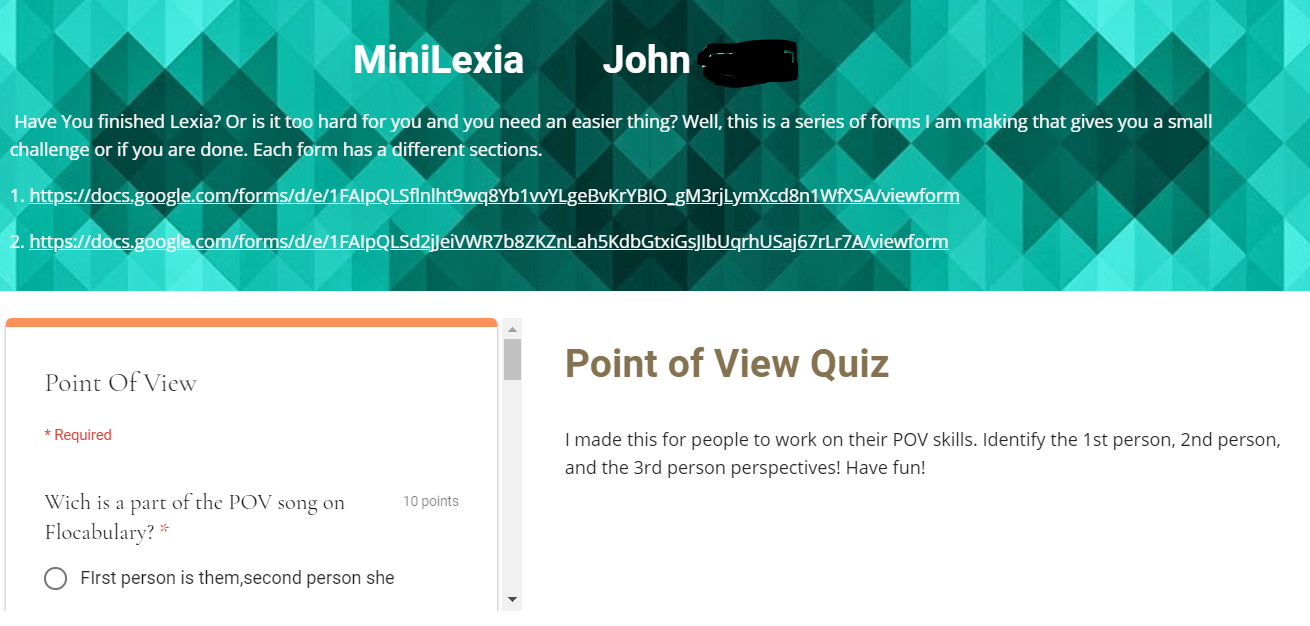 |
| John's Mini Lexia Quiz and a Point of View Google Form |
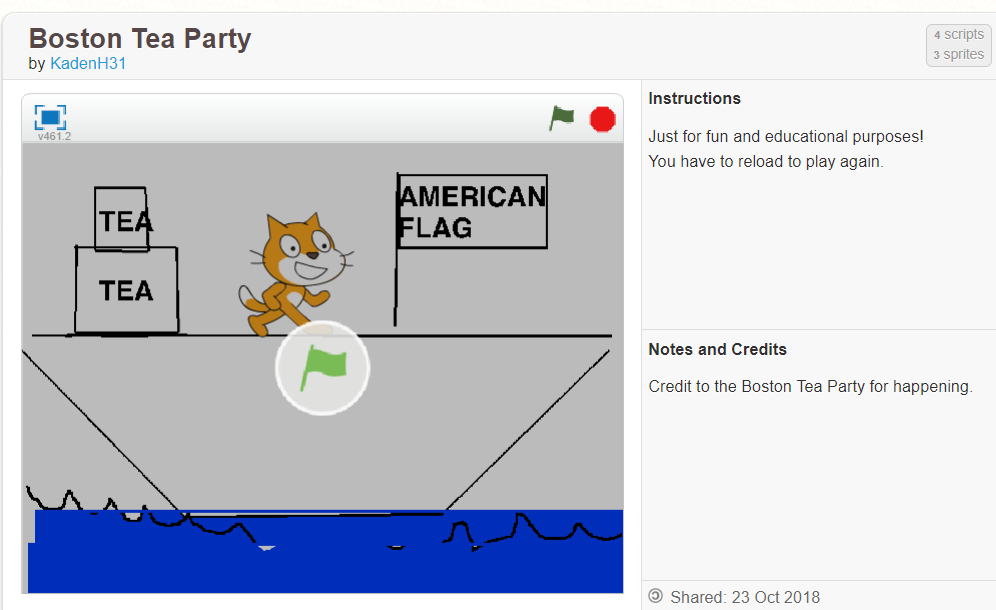 |
| Kaden's Boston Tea Party Scratch Game |
In closing, Mrs. Johnson points out, “I was most surprised with how smooth the transition has been and how little guidance is needed. My students are extremely self-driven and self-motivated with this website. I am impressed with the variety of products that they have created as a result of this website. I am also thrilled about how excited they are to create so many different projects.” She adds, “One of our campus initiatives is to raise the level of Masters scores by 10%. I definitely believe that by doing these types of self-initiated projects, our students will show growth in their reading and thinking abilities.”
Be on the lookout for some of these student created products at EXPO 2019!
Monday, November 12, 2018
Juxtaposing Student Voice & Choice w/ AP Exam Test Prep
When your Senior level AP course doesn’t have TEKS and is primarily focused on preparing for the AP exam, there is not much room for student creation and choice, right? WRONG! AP English IV (AP Literature and Composition) teachers Denise Tennison and Brittany Harper at Byron Nelson High School look for innovative ways to prepare the student, while engaging them in the learning that goes beyond traditional test prep. What better way for students to learn question analysis than to create AP-level questions themselves. Futhermore, they stepped into the teacher role and used formative assessment websites, like Quizizz, Socrative, and Mentimeter, to create student-made quizzes with a future audience of their own peers. Talk about real world application, authentic audience, collaboration, and student choice - all wrapped up into one!
This task’s purpose was multifaceted as it aimed to 1. Analyze Othello, and 2. Apply knowledge and syntax of the 12 English Literature and Composition Question Types. Specifically, it challenged students to CONSTRUCT AP questions in order to be more prepared to DECONSTRUCT them on the exam as it will be easier to answer high-level questions if students have an understanding of how they are originally developed.
Project Instructions:

In the past, this project stopped at Step #4 above in which the student solely created the questions on a collaborative Google Doc. Although these did provide a sample set of study questions, they weren’t interactive, thus many peers read over them without truly applying their thinking to answer and engage with the content. Furthermore, there wasn’t an authentic audience since it was simply a paper turned in to be graded by the teacher. To provide a more engaging experience and incorporate student choice, Tennison and Harper brainstormed applicable product choice websites using the Tools that Make IT Click resource to identify a set of options that would work well for this assignment.
Benefits of designing student choice lessons with multiple tool options:
- Students have power over the tool they chose.
- They are more engaged in the process because they were able to break out of the “one-size-fits-all” approach in which every students' experience is identical.
- Students can apply prior experience with tools they have used in other classes to understand which tool most appropriately applies to their content.
- Neither the teacher or students need to be “tool-expert.” There are so many resources that are Google-able to understand how a tool works; plus, students typically are able to figure site features out quicker than many adults.
- If a tool doesn’t fit one groups’ needs or isn’t as easy to understand, just pick another platform!
Example #1:
Students: Cavnar, Dumble, Felten, Pham, Cobb, Hinshaw
Formative Assessment Tool: Socrative
Play along HERE! Room Name: CAVNAR

Example #2:
Students: Edwards, Ye, Holt, Plocek, Mauer, Young
Formative Assessment Tool: Quizizz

Students’ feedback on this project was very positive. Because of the collaborative group nature, these teachers overheard really good conversations taking place as students discussed Othello, compared the 12 question types to best assign various formats to their content, and wrote a challenging question and designed relevant distractors. When it came time to enter these into the formative assessment site, students were able to collaborate in discussing their prior experience with various sites as they weighed the benefits and downfalls of each in order to connect the best type of tool to their content needs. Additionally, they were able to design the type of experience they would most like to participate in such as choosing sites that use gamification, whole class/group vs. individual quizzes, and embedded opportunities for detailed student feedback. The final products will support students two-fold: allowing the student to be the “teacher” in designing the content, as well as letting the student be another peer's student by taking each other’s assessment’s now and in the Spring to prepare for the exam. Adios traditional, boring test prep!
Monday, October 29, 2018
All Aboard: Where Hovering Dreams Become a Reality
“A dream doesn’t become reality through magic; it takes sweat, determination, and hard work.”
-Colin Powell
I think back to when I was a kid, thinking about how there would definitely be flying cars in the future. Shows and movies like “The Jetsons” and “Back to the Future” made these dreams a quasi-reality for us. Unlike three of Prairie View Elementary’s finest leaders, I was waiting for someone else to make this idea come to fruition, it never happened.

 Under the direction and guidance of Ms. Spann, the three 5th-grade engineers began to set-off on developing their idea in Tinker Cad, a design program that can then connect to a 3D-printer to print out their designs. In discussing their design process, Christopher stated that “We know that it has to be aerodynamic, which is why the front of the train will be rounded, to allow the air to push around it on all sides.” Through the process of designing the train itself, they have had to problem solve how they intend to make it hover. Ethan suggested that “electromagnets within the train and surrounding the tunnel will allow the train to stay off the ground,” as he pulls up his Youtube video research.
The beauty of learning in a district such as NISD, educators know where there is a will, there is a way. It just so happened that the NISD STEM Academy at Northwest High School had recently posted about their culminating project after experiencing first hand what the engineering process looks like. Ms. Elizabeth Mitias, the teacher of the Aerospace and STEM Principles classes, gladly accepted the challenge of having some of her seniors mentor our three emerging scientists. Coordinating schedules, Ms. Spann and Ms. Mitias set out to schedule a Zoom Conference between the two groups of students. The Prairie View students were excited at the opportunity to hear from “experts” in the field that they were working in. They began preparing talking points and questions that they would ask the seniors.
Finally, the day of the meeting arrived. Ethan, Connor, and Marla, senior students from Ms. Mitias’’ class, were eagerly awaiting the arrival of the young engineers. The meeting commenced with an introduction to the engineering process where the seniors discussed their experiences in creating their spacecraft. Connor reiterated the idea that “It is necessary to get feedback from multiple perspectives when creating a project because a fresh pair of eyes can help you see things that you may have missed before.”

When asked about their experiences throughout this whole passion-project, the boys were ecstatic to share how they were feeling. Ian stated, “I feel smart. I feel like a brainiac. I feel like I’ve done something nobody’s ever done before.” Ethan expressed, “It feels like what we are doing is experimental. We are figuring out problems that we’ve never done before.” Excited by the opportunity, Christopher shared, “I am just so eager to learn more about aerodynamics and electromagnets, and it feels like this is something that we can really make happen.” Ms. Spann, who supported this project from its conception, expressed, “I love that this whole project was intrinsically motivated. The students had the idea and set out to find a way to make it happen, all on their own. They never had a question of if, just who would be willing to give them the space to make their dreams come true.”
By empowering our students to find what they are passionate about, these Prairie View Leaders exemplify the necessity to fulfill the mantra, “Where there is a will, there is a way.” This truly embodies Leader In Me Habit #4 as this is a WIN-WIN for all involved.
Monday, May 21, 2018
Giving Students the "Keys" to Engage
 Many adults
falsely assume that the current generation of students is lacking any sort of work
ethic, loyalty, or desire for learning independence. Some mistakenly stereotype an entire generation of students as full of apathy and an inability to think critically or engage
with a world outside of social media. What many fail to
see is that we are educating a generation of individuals who may have more
intrinsic motivation than we realize. The challenge we face is not how
to teach students these qualities but to find ways to bring them out in our
students and give them opportunities to apply the necessary thinking to content as
they learn to grow and develop the skills we desire to see.
Many adults
falsely assume that the current generation of students is lacking any sort of work
ethic, loyalty, or desire for learning independence. Some mistakenly stereotype an entire generation of students as full of apathy and an inability to think critically or engage
with a world outside of social media. What many fail to
see is that we are educating a generation of individuals who may have more
intrinsic motivation than we realize. The challenge we face is not how
to teach students these qualities but to find ways to bring them out in our
students and give them opportunities to apply the necessary thinking to content as
they learn to grow and develop the skills we desire to see. In his first year at Eaton High School, Canaan, a
Business Management and Entrepreneurship Academy student, was brainstorming for a Junior Achievement Company idea and had a desire to do something that had a “real effect on the world” or solved a real-world problem.
He also happened to read an article about human sugar intake and how it was
linked to diabetes, cancer, and other health problems. As Canaan continued his research, he watched a documentary on the topic, which spurred him to begin
tracking his own sugar intake for about a week. He started tracking it on paper
and saw that his own sugar intake far exceeded the amount recommended. His
research supported that this was not uncommon and Canaan's very startling discovery
prompted him to think about how important is was for people to understand
and be aware of this issue. Through his research and continued tracking, Canaan’s
interest in this area grew and he wondered if there was an easier way for
people to track their own sugar intake. He found few apps and tools online to
help and even researched some of the major personal health trackers. While
looking at some of the more widely used digital trackers, he found that their primary function
was to count calories and fat and that most of them grossly underestimated
grams of sugar in foods he consumed. Canaan knew there must be a way to create something
to meet this increasing need and started looking for courses at school that would help
him pursue this new found interest.
In his first year at Eaton High School, Canaan, a
Business Management and Entrepreneurship Academy student, was brainstorming for a Junior Achievement Company idea and had a desire to do something that had a “real effect on the world” or solved a real-world problem.
He also happened to read an article about human sugar intake and how it was
linked to diabetes, cancer, and other health problems. As Canaan continued his research, he watched a documentary on the topic, which spurred him to begin
tracking his own sugar intake for about a week. He started tracking it on paper
and saw that his own sugar intake far exceeded the amount recommended. His
research supported that this was not uncommon and Canaan's very startling discovery
prompted him to think about how important is was for people to understand
and be aware of this issue. Through his research and continued tracking, Canaan’s
interest in this area grew and he wondered if there was an easier way for
people to track their own sugar intake. He found few apps and tools online to
help and even researched some of the major personal health trackers. While
looking at some of the more widely used digital trackers, he found that their primary function
was to count calories and fat and that most of them grossly underestimated
grams of sugar in foods he consumed. Canaan knew there must be a way to create something
to meet this increasing need and started looking for courses at school that would help
him pursue this new found interest.
Canaan
eventually signed up for William Gilbert’s web applications course where he
could acquire basic knowledge for coding and building apps on his own.
Mr. Gilbert recalled Canaan approaching him about one of the course assignments
and asking to incorporate his ideas for sugar tracking. Mr. Gilbert said that “He
changed the assignment when he came to me about his research and asked me to allow him to do
something different and more complicated.” Gilbert allowed Canaan the opportunity to pursue his area of interest and Canaan turned it into Bloom, an app for sugar intake tracking.

Canaan has since
continued to update and work on his app and has an entire notebook, or journal,
for ideas he plans to incorporate. He did say that he was a bit disappointed
that there were only so many courses he could fit into his schedule to advance
his desire to code and develop apps. However, Canaan continues to record suggestions
from classmates and gathers outside feedback to help him continue developing
ideas for evolving his app. He plans to develop this web based application that
can also be accessed from a computer or a smart phone and wants to incorporate
a variety of convenient features in the future to help with more accurate tracking of sugar intake.
Without the opportunity provided in our BME academy to creatively think about societal needs and possible business ventures and without the willingness of Mr. Gilbert to hand over the “keys” to learning to his students, Canaan’s idea would not have come to fruition. It’s his personal drive to make a difference and the willingness of Canaan's teachers to facilitate and open up this opportunity that drove Canaan to conceptualize his "passion project" while also learning useful and relevant academic skills.
Without the opportunity provided in our BME academy to creatively think about societal needs and possible business ventures and without the willingness of Mr. Gilbert to hand over the “keys” to learning to his students, Canaan’s idea would not have come to fruition. It’s his personal drive to make a difference and the willingness of Canaan's teachers to facilitate and open up this opportunity that drove Canaan to conceptualize his "passion project" while also learning useful and relevant academic skills.
Mr. Gilbert’s
web applications course also allowed three other innovative students an
opportunity to develop tools that not only met a course requirement, but also
addressed a need in the Eaton UIL community. Nate and two of his peers, Devon
and Nate, are part of the Eaton UIL computer science team. While at
competitions, they noticed that results were usually printed on a single 8½ x
11 sheet of paper and posted on a wall in the school cafeteria for a bunch of
students to crowd around and try to decipher. They felt that this method of
sharing competition results was much “more difficult than it should be” and they worked together to develop an app that works with current University InterscholasticLeague (UIL) event tabulation procedures for electronically communicating competition results.

The app was deployed at an Eaton UIL competition last year and worked
incredibly well for electronic dissemination of news updates and scores and
efficiently communicated rounds and results to all students and coaches. Nate
said that he liked how the app “alleviated a disconnect between scorers and competitors.”
It worked so well that these students decided to add in speech event tabulation
to the app for the 2018 Eaton UIL tournament. The feedback from their endeavor was all positive and noted how well these students served a legitimate need in the school community.
Another group of students who utilize passions and skills acquired through academic course study can be found in Eaton High School’s Book Club, sponsored by the EHS Library Media Center. Crystal and Jasmine are prominent book club members and say they joined book club because they school helped them to acquire a love for reading and they wanted to connect with friends who also loved to read. Jasmine, specifically, appreciated that Mrs. Sarah Thomasson took an interest in her, as a new student who was previously home-schooled, and showed her that she could reach out to others in the group by joining book club and getting involved with the YouTube channel, called "ISBN Thinking," produced by its members.

The channel was
started after members students, who had an interest in other online book reviews, realized that they had all the skills and resources necessary to produce something similar,
and according to Crystal, “We knew we could do it better.” The students worked
with Mrs. Thomasson to utilize library resources for recording of online book
talks and originally used a back room in the EHS library for producing and
editing of their videos, which they learned to do with the knowledge gained in
several of their classes and with the help of Mrs. Thomasson. The EHS Book Club meets during lunch shifts or Eagle Time to film and they have produced video reviews of books available through the Eaton High School Library.
These students also make an effort to cover all of the North Texas “Battle of the Books” texts and involve all twenty-two
members of book club in reviewing books and filming
talks.
The group is
currently not posting new videos because they are in need of a new location for filming
and hope to find a suitable and accessible location at EHS very soon
as they have plans to increase filming on a more regular basis and to organize the group with a set schedule and structure that they believe will provide added online and library traffic. These students love being able to share their own passions for reading, critical analysis, and video production through this very
relevant educational outlet that is meant to strike a love for
reading in other EHS students.
Obviously, there
are an innumerable amount of opportunities for students at NISD to find and
pursue individual passions through academic study. Allowing students to take
control of those opportunities and push themselves forward are what will empower
and motivate them to positively engage with and change their community. These students are part
of a generation described by many adjectives but apathetic, disengaged, and
lazy should not be part of them. This generation is motivated to go above and beyond in pursuit of things that are important to
improving the world around them if educators will only help them to engage in content
in ways that interest them. With an
amazing wealth of tools to help students access those opportunities and fuel the
desire to do more than consume technology and resources they can create in ways
that will permanently benefit the world.
Subscribe to:
Posts (Atom)