
Showing posts with label EXPO. Show all posts
Showing posts with label EXPO. Show all posts
Monday, November 27, 2023

Wednesday, March 22, 2023
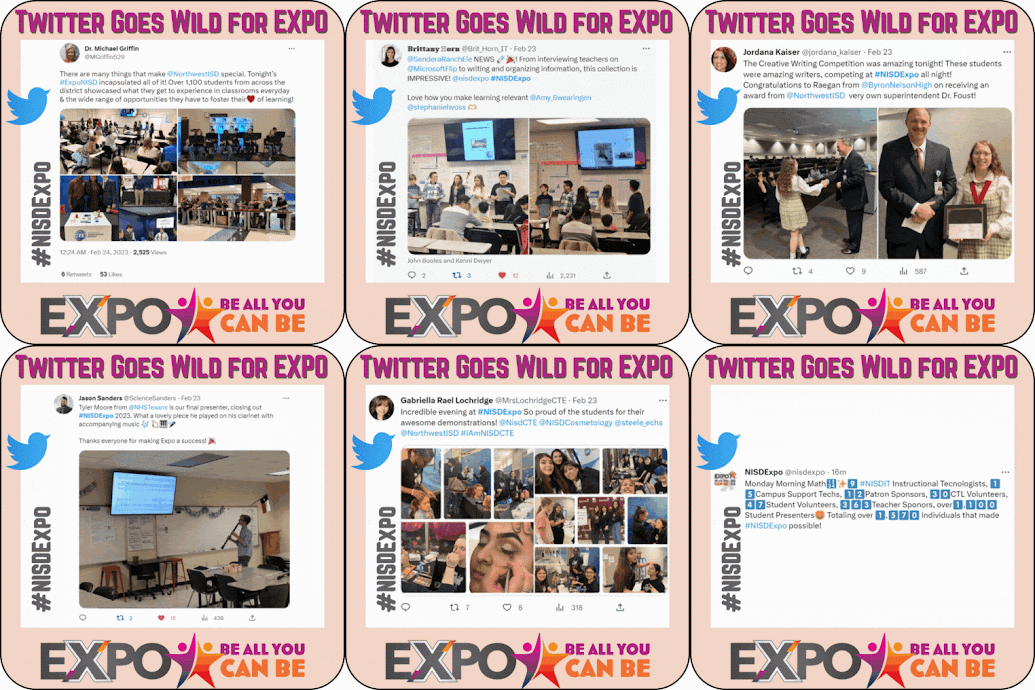
EXPO: Be All You Can Be 2023




Monday, March 2, 2020
Not Just Students, PODCASTERS! Sharing Our Learning One Episode at a Time

An Ongoing Routine:
 |
| Mrs. Webster's Podcast Wall |
 Mrs. Webster doesn’t grade podcasts or require a certain number of episodes. This is why seeing that some students have 10-15 episodes is so powerful. Mrs. Webster has also equipped her students to be quality control for the episodes. “As a class, we listen to each other and give feedback on the planning, pausing, summarizing, pacing, etc.” In regards to making time for podcasting, podcast reflections have become a part of Mrs. Webster's afternoon ELA stations. If some students are unable to get to the podcast station, they make time for them to complete the next morning first thing.
Emery, Claire, Nick, and Henry have especially enjoyed their podcasting journey. Emery states, “I love being a podcaster because I get to tell people how I feel, what I’ve been working on, and what I’ve learned.” Henry adds, “I like that I get to work with a partner and choose what my podcast is about.” Claire’s favorite part of podcasting is interviewing other people to see what they’ve read and how they’re doing. Nick loves that they get to work and have fun at the same time.
SEL (Relationship Skills and Social Awareness)
 |
| Emery and Claire Working Together to Record an Episode |
Nick has realized that through his podcasts, he has the opportunity to encourage others. He states, “If someone is sad, we might be able to cheer them up. We try to be really positive. My favorite episode is number eight when I’m talking about my friendship with Henry.” In this episode Nick and Henry talk about their similarities and differences, but how they’ve remained friends regardless of their differences.
Making Connections

"Knowing that we're going to record a podcast over the books we've read, makes reading even more purposeful." Claire adds, "Podcasting makes me more excited about what I’m reading. It makes me think about how the characters are feeling and how characters change, so I can talk about it on the podcast." Emery points out, "We go back to our books to remember how characters were feeling. Their actions show how they’re feeling."
In addition to recording episodes about books they've read, students have written their own stories and fairy tales! They’ve enjoyed interviewing each other as authors. Emery recorded an episode over a story that Claire wrote, titled, “Lucky Puppy.” On the episode Claire states, “This book really has a connection to me and my life when I was little.”
Mrs. Webster states, "I love all of the episodes, but some of my favorites are when the students make connections with the books they have read and discuss how a book may have impacted them deeply. There seems to be something magical that happens within the physical act of talking it out for them on a podcast. When students are recording in a smaller group, they tend to express deeper thoughts than maybe they would have written down or shared in a whole group setting. At times, they can get really deep and other times they can get really silly, but overall, they feel completely safe in sharing their unique personalities and creative ways throughout the podcast, and this I absolutely LOVE with all my heart!"
Next Steps:
 |
| Sharing Our Podcasts at Expo 2020 |
Henry would like his next episode to be about a current favorite book of his, "Flames of The Tiger" by John Wilson. I'm sure there are many more podcast episodes to come from Webster's 3rd grade class. They are also interested in sharing their episodes outside the walls of their classroom, possibly with one of their favorite authors.


Monday, September 23, 2019
When Characters Come Alive

"All Summer in a Day" is a Science Fiction short story by Ray Bradbury. Cooper gave her students a digital copy though Google Classroom, which streamlines the process of sharing files between teachers and students. As they read the story they used Kami to annotate the text. Students focused on the characterization of Margot as they read.When finished, an analysis of the text which included looking at elements such as point of view, figurative language, and theme was done. Once students completed that task, they began compiling all of their knowledge of the text to incorporate into the final task.

To begin, Cooper used Flippity to do a random group generator. The kids weren’t thrilled that they didn’t get to choose groups, but Flippity eliminated that potential management struggle. Next, students created a Google Doc, which they collaborated with each other on, shared with the teacher, and begin creating a script. Students were tasked with creating a “talk show” style script where there would be hosts who interviewed the two main characters of “All Summer in a Day”, Margot and William. Students had to create 3 questions per guest and formulate their response based on inferences from the text and the characterization of Margot and William. Finally, once students finished their script, they used Flipgrid to record themselves hosting their talk show. This gave quiet students a voice, it allowed us to see the profound thoughts you didn't know were there, and took their learning to a deeper level than you thought possible for this learning opportunity. 
 |
| Student Talk Show Example |
 |
| Student Talk Show Example |
Monday, February 25, 2019
Let's Be (proportionally) Reasonable
 When was the last time you stopped to think about ratios and proportions? It’s a strong possibility that you’re reading this and are actually questioning yourself. You probably haven’t consciously thought about these two math terms since you were introduced to them in one of your math classes. The reality is, knowledge of proportions can play a bigger role in your daily life than you even realize. Mrs. Harris and Mrs. Butler at Medlin Middle School are on a mission to find real world application for these standards.
 So, naturally, the most commonly asked question by students in a math class gets asked: “When will I ever use this in the real world”? In an attempt to begin answering that question, let’s think about a recent Target run or trip to Costco. Knowledge of ratios and proportions likely played a role in some of the decisions made. Even the car being driven down the highway to these two stores is being driven a certain number of miles per hour. Think about the ads seen online or in store. Many things are advertised as 2 for $5. Or the consumer doing math to figure out the better deal on paper towels and toilet paper. Maybe it’s a recipe that needs to be doubled. These are all just a sampling of the unit rate proportions one might encounter on any given day.
 |
| (Click to view project) |
Students were challenged to apply their learning about proportions from their 6th/7th grade compacted math class to real life. This meant it was time to identify which routines and decisions throughout their day involved proportions. From the time they woke up until it was time to go to bed, where could they apply this mathematical skill to real life? It was their teacher’s hope that it wouldn’t take long for students to come to the understanding that proportional reasoning is not just stuck in their math book. It is literally playing a part in many areas of their everyday life. The better question just might be, “When will I NOT use in the real world”?
 |
| (Click to view project) |
Projects would need to include six examples of real world proportional situations presented in the form of a question for their peers to work out. Their work would also need to include a fully worked out answer key for their proportional situation examples. It was up to the students to determine how they would present their work. Many chose to create an interactive presentation using hyperlinked Google Slides and some even decided to bring theirs to life through video. Others created a Google Site. Some chose a more traditional style route and created a poster board that represented their proportional reasoning. Harrison and his partner, Drew created a video. He said, “We used my editing software and green screen from home. We enjoyed this project because we were able to show everything we know about proportions and ratios while also showing the things we enjoy doing”.
 |
| (Click image to view project) |
At the end of the unit, students were equipped to recognize ratios and proportions all around them. They’re more prepared for the real world because they understand the importance of being a smart consumer and how simply paying attention to advertisements and unit ratios can influence purchasing decisions. There was definitely buy in for the importance of math outside the classroom. The habit of proportional reasoning was there all along, they just simply needed to see it applied and made personal to them. “I enjoy using technology because it gives you more options on projects, and allows you to be more creative with how you do things”. The added layer of integrating technology was definitely a highlight for Drew.
Some of the projects created during this unit will be showcased at the district’s Expo event on the evening of February 28th. Students are eager to share their “math in the real world” experience with an authentic audience.
Tuesday, February 19, 2019
Collaboration that BLEW our Mind and FLOODED our Learning!
“This project was so cool! We got do our own research and meet 7th graders who learned about tornadoes and floods too.” -Alondra (4th Grade Hughes Elementary)
From research to organization to collaboration, and then feedback and revision, students in Mrs. Turner and Mrs. Covarelli’s class had a learning experience that they won’t forget!
It just so happened that 7th grade students at Tidwell Middle School were learning about catastrophic events the same time that these 4th grade students were doing research. Mrs. Wellborn and Mrs. Christian's were part of a scheduled ZOOM meeting that allowed them to provide feedback for 4th grade and share a little about what they learned about tornadoes, floods, and the effects these disasters had on the environment. “It was nice to hear feedback so that we could fix parts of our website," Said Alondra. She added, "it was also nice because when we were texting (AKA: typing on collaborative Google Slides), my partner sent us a link to their 7th grade project. It was cool to learn more facts from them.” Naomi added, “I liked that we got to learn with the 7th graders that we got to see some of what we are going to learn in 7th grade. We even got to meet our future 7th grade teachers!”
Global Collaborator
 |
| Virtual Connection via Zoom |
From research to organization to collaboration, and then feedback and revision, students in Mrs. Turner and Mrs. Covarelli’s class had a learning experience that they won’t forget!
As a part of a Lucy Calkins unit, students were put into groups based on interested level to research a natural disaster or weather event. They were responsible for taking the overarching topic and creating subtopics within that. They did their own research, took notes, and cited sources to write a final essay with their research. After writing the essay, groups then created videos using FlipGrid to share what they learned about their event.
RESEARCH AND WRITING:
According to Alondra, the most challenging parts of this project was the research. “When you type too much in your search, sometimes you don’t get what you need. We had a hard time finding just the right information.” Mrs. Covarelli agreed that research was the most difficult part for her students. She points out, “Students struggled with how to use keywords in search engines to find the results they were hoping for. We did mini lessons on how to use keywords when researching. Some students also had a hard time finding research on their subtopic, so they changed subtopics based on the research they were finding online.” Alondra added, “Our teachers helped us by giving us safe search websites. It was nice that Mrs. Covarelli was protecting us from any bad websites.”
ORGANIZING AND PUBLISHING:
Two specific groups took their information and organized it within a Google Site to submit for Expo 2019. Naomi's group researched floods. She states, “I liked creating a Google Site with my group because we could all work together. We could see each other’s work and get feedback from each other. If someone was absent we could still see their work.” Mrs. Turner helped students learn the importance of organizing a website and making information engaging and clear for others. Students added their Flipgrid video to the website along with photos, and even maps to bring their research to life for their audience.
COLLABORATING AND RECEIVING FEEDBACK:
 |
| 7th Grade and 4th Grade Partner Up on Collaborative Slides |
 |
| Mrs. Wellborn and Mrs. Christian Meeting 4th Grade Students at Hughes Elementary |
SHARING: Not only did these students share their site with 7th graders, but they have also been selected to present at Expo 2019! Come learn more about their experience on February 28th! "I'm so excited about Expo. I went in 2nd grade, but I’m glad to get to share my project again this year," said Aislynn. “I’m very excited about Expo. It’s my first time doing it,” added Naomi. For Adelais, this will be her second time at Expo. “ I went in 2nd grade, but I’m glad to get to share my project this year and even see other people’s projects.” Presentation times can be found at: https://expo.nisdtx.org/
Click the images below to view student websites:
ISTE STANDARDS:
 |
| Floods by Aislynn, Landon, Yosari, Lia, Rachel, and Naomi |
 |
| Tornadoes by Adelais, Alondra, and Bella |

ISTE STANDARDS:
Knowledge Constructor:
- 3a - Students plan and employ effective research strategies to locate information and other resources for their intellectual or creative pursuits.
- 3b - Students evaluate the accuracy, perspective, credibility and relevance of information, media, data or other resources.
- 3c - Students curate information from digital resources using a variety of tools and methods to create collections of artifacts that demonstrate meaningful connections or conclusions.
Creative Communicator
- 6a - Students choose the appropriate platforms and tools for meeting the desired objectives of their creation or communication.
- 6b - Students create original works or responsibly repurpose or remix digital resources into new creations.
- 6c -Students communicate complex ideas clearly and effectively by creating or using a variety of digital objects such as visualizations, models or simulations.
- 6d - Students publish or present content that customizes the message and medium for their intended audiences.
Global Collaborator
- 7a - Students use digital tools to connect with learners from a variety of backgrounds and cultures, engaging with them in ways that broaden mutual understanding and learning.
- 7b - Students use collaborative technologies to work with others, including peers, experts or community members, to examine issues and problems from multiple viewpoints.
- 7c -Students contribute constructively to project teams, assuming various roles and responsibilities to work effectively toward a common goal.
Monday, December 10, 2018
Gettin' Sketchy With It!
 Third grade GATES students at Lakeview Elementary have been focused on Architectural Design. As an introduction to their learning, Mrs. Blake read aloud Iggy Peck, Architect by Andrea Beaty. They also spent time researching famous structures around the world using various depth and complexity icons to identify patterns, details, and how their structure has ethically impacted the environment. This then led into an architectural details hunt, where students viewed houses and identified exterior details from their research. Their language of the discipline deepened throughout this initial study as students prepared to design their own city.
With inspiration from Iggy Peck’s Blue River Creek Challenge (found in the Iggy Peck’s Big Project Book) students began focusing on attributes of a town and what it should include. The components outlined in the book included: school, library, factory, office buildings, shops, city hall, zoo, fire/police stations, and a building design of their choice (ex: a church or museum). Students set to work on creating their own town with the outlined parameters. As part of the project requirements, they were tasked with creating both an aerial and street view rendition of their town.

As part of their studies, experts from the field visited their classrooms. Brandon Blake, from Blake Architects, visited to discuss the design process from the architect’s perspective. He showed students examples of blueprints and models from projects he’s personally been a part of. These artifacts provided an up close look at how important scale images and models are to both the client and the builder. Blueprints and scale models allow both parties to visualize the client’s request and identify areas that need additional attention to detail. He stressed the importance of getting to know the client and understanding their vision.
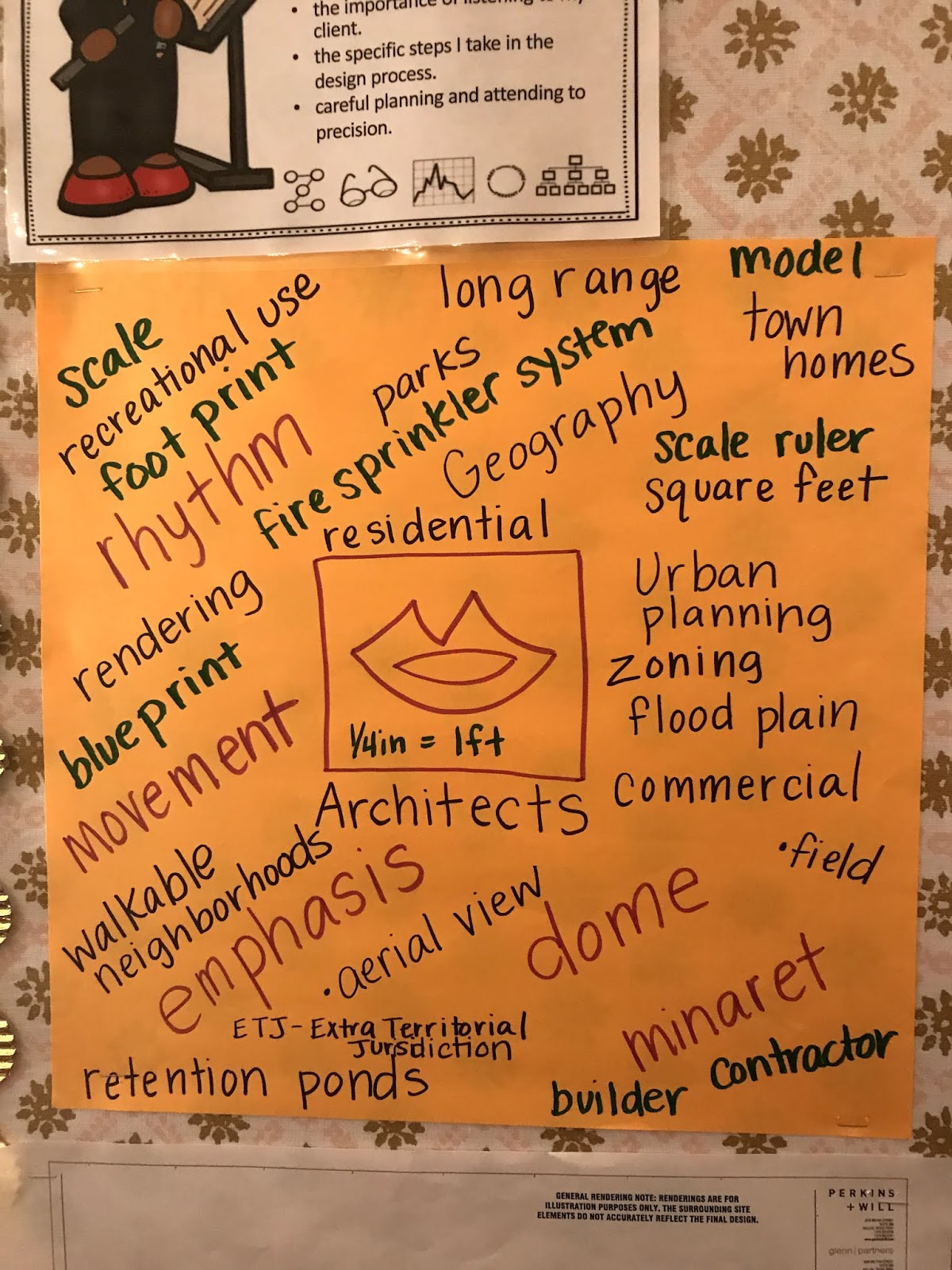
 Lisa Payne, Town Planner in the Community Development department in the Town of Trophy Club, also visited to discuss urban planning. She deepened their thinking by sharing the importance of long range planning that is mindful of the community and its resources. Relevant information was introduced as she spoke about future projects planned for the Town of Trophy Club. One of the projects specifically shared was the Byron Nelson Field House, currently under construction. Knowing that many of these third graders will one day utilize that facility brought much excitement to the room.
 During both of these visits, students were able to ask the experts questions that would lead them to be more successful in their own design process. They developed a language of the discipline that would be carried with them throughout the project. It was especially neat to watch students roll up their “blueprints” in true architect form, just as they saw Mr. Blake do during his visit. Annabell said she has enjoyed this study because, “as a little kid you might want to grow up to be an engineer and this project is a really great start”. Providing relevant, real world experiences for students can open the doors to so many possibilities.


Monday, December 3, 2018
Permission to Be Creative!
 Mrs. Johnson (a 5th grade teacher at Granger Elementary) created a collaborative Google Site with the purpose of expanding learning in the ELA and social studies classroom. On the homepage of the site, students find permission to be creative! The site reads, “This will be a place for you to take your learning to the next level by using your creative mind to build on what you’ve already been learning about in class. Think outside the box, explore new ideas, and discover topics that you’d like to know more about.” The license to be creative has led to student ownership that can hardly be put into words.
How did this site come about? Mrs. Johnson states, “Some students finish their classwork quickly and need to have a project to work on, or they need to be challenged to take their learning to the next level. I also have students who simply thrive when having projects to work on. I had many students who fell into these categories this year, and I really wanted provide them with more than just the everyday ELA and social studies classwork. With a blue crayon and a piece of notebook paper, I began jotting down their suggestions. We came up with a few ideas, such as making Google Slides, designing games, and creating Kahoot quizzes. Then, I asked these students about some of their topics of interest. That afternoon, I took their suggestions and organized them into a Google Site. By adding their ideas to the site in an organized way, many more ideas started flowing. I added more ideas of my own, and then I gave about seven students access to this site so that they could add more ideas. Together, we formed the basic structure of this enrichment site.”
Here is how the site works. 1. Students use the “Topics” and “Activity Option” pages to gain inspiration and decide on a creation project that they are interested in. 2. Students click on the timeline spreadsheet and sign up to create a project. 3. Students create the project of their choice using the tool of their choice. 4. Students insert their project into the “Finished Projects” page. 5. Students record a FlipGrid video explaining the what, why, and how of their project. They also explain how their project will impact other students and reflect on what they would have done differently if they were to do the project again.

Students lit up as they shared about their projects. Samanvita, Amari, Kaden, Shabbeer, and John could have chatted for hours about projects they had created and project ideas that were marinating in the back of their mind. "It's not like other classes because we’re getting to chose what we create" said Kaden. "It's really cool," says Amari with a smile, "It's like we are student teachers!"
Samanvita shares a little about her creation, “I made a Powtoon about point of view, a WeVideo about story elements, and there is is lego website that I’m hoping to make a Stop Motion video from. Right now, I’m using Tinkercad to create a gun from the Revolutionary War. I also made a George vs. George quiz. I think I made it a little too tricky because most people only got 30%.” Samanvita asked me to take the quiz and I’m sad to say that I failed as well. All that said, she had feedback woven within the quiz and was able to help me learn from my mistakes.
Other created projects include, a 3D print of the Boston Tea Party ship, a mini Lexia series to help others who may want extra practice, various Kahoot and Google Form quizzes over covered topics, and even stop motion videos. According to these students, the most challenging aspect of the project is time management and choosing the right tool for the resource that they are making. They are learning that some tools are limited and they need to be purposeful when choosing. Many of these students get excited about their projects and end up working both at school and at home.
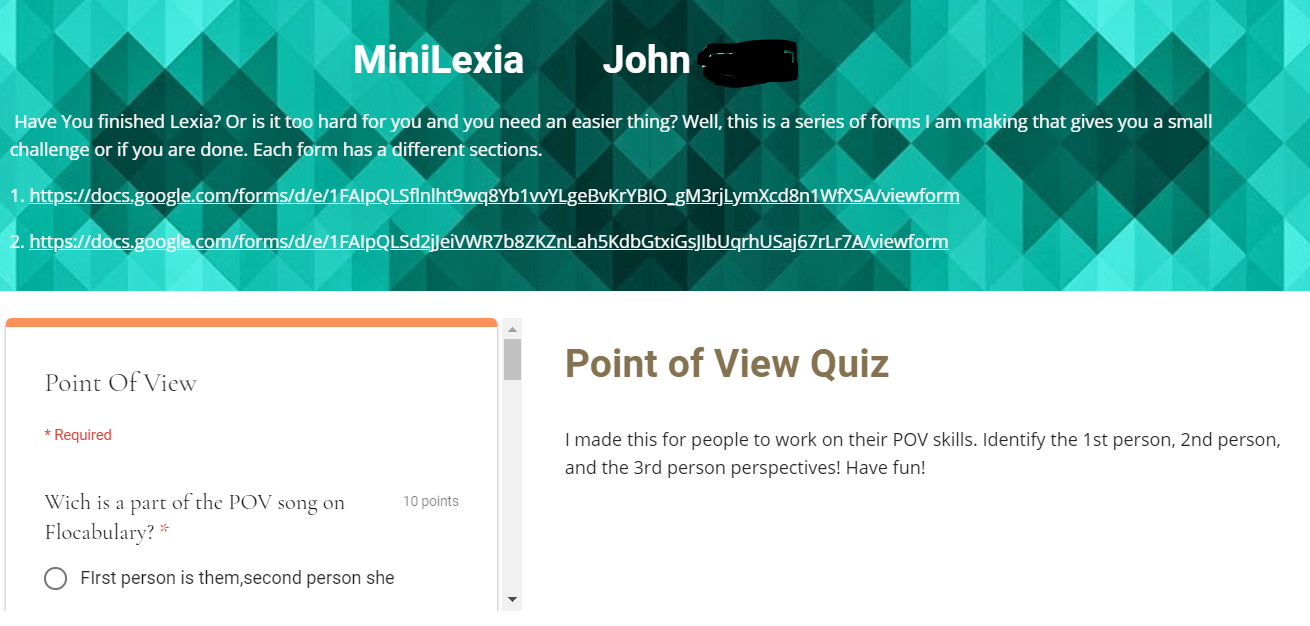 |
| John's Mini Lexia Quiz and a Point of View Google Form |
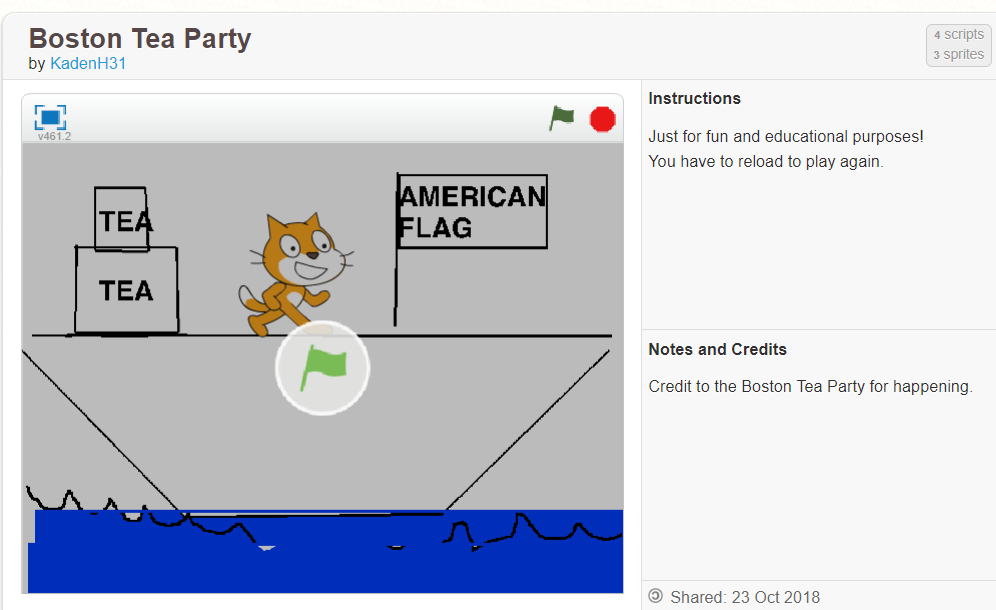 |
| Kaden's Boston Tea Party Scratch Game |
In closing, Mrs. Johnson points out, “I was most surprised with how smooth the transition has been and how little guidance is needed. My students are extremely self-driven and self-motivated with this website. I am impressed with the variety of products that they have created as a result of this website. I am also thrilled about how excited they are to create so many different projects.” She adds, “One of our campus initiatives is to raise the level of Masters scores by 10%. I definitely believe that by doing these types of self-initiated projects, our students will show growth in their reading and thinking abilities.”
Be on the lookout for some of these student created products at EXPO 2019!
Subscribe to:
Posts (Atom)