Showing posts with label Writing. Show all posts
Showing posts with label Writing. Show all posts
Monday, November 28, 2022

Monday, March 2, 2020
Not Just Students, PODCASTERS! Sharing Our Learning One Episode at a Time

An Ongoing Routine:
 |
| Mrs. Webster's Podcast Wall |
 Mrs. Webster doesn’t grade podcasts or require a certain number of episodes. This is why seeing that some students have 10-15 episodes is so powerful. Mrs. Webster has also equipped her students to be quality control for the episodes. “As a class, we listen to each other and give feedback on the planning, pausing, summarizing, pacing, etc.” In regards to making time for podcasting, podcast reflections have become a part of Mrs. Webster's afternoon ELA stations. If some students are unable to get to the podcast station, they make time for them to complete the next morning first thing.
Emery, Claire, Nick, and Henry have especially enjoyed their podcasting journey. Emery states, “I love being a podcaster because I get to tell people how I feel, what I’ve been working on, and what I’ve learned.” Henry adds, “I like that I get to work with a partner and choose what my podcast is about.” Claire’s favorite part of podcasting is interviewing other people to see what they’ve read and how they’re doing. Nick loves that they get to work and have fun at the same time.
SEL (Relationship Skills and Social Awareness)
 |
| Emery and Claire Working Together to Record an Episode |
Nick has realized that through his podcasts, he has the opportunity to encourage others. He states, “If someone is sad, we might be able to cheer them up. We try to be really positive. My favorite episode is number eight when I’m talking about my friendship with Henry.” In this episode Nick and Henry talk about their similarities and differences, but how they’ve remained friends regardless of their differences.
Making Connections

"Knowing that we're going to record a podcast over the books we've read, makes reading even more purposeful." Claire adds, "Podcasting makes me more excited about what I’m reading. It makes me think about how the characters are feeling and how characters change, so I can talk about it on the podcast." Emery points out, "We go back to our books to remember how characters were feeling. Their actions show how they’re feeling."
In addition to recording episodes about books they've read, students have written their own stories and fairy tales! They’ve enjoyed interviewing each other as authors. Emery recorded an episode over a story that Claire wrote, titled, “Lucky Puppy.” On the episode Claire states, “This book really has a connection to me and my life when I was little.”
Mrs. Webster states, "I love all of the episodes, but some of my favorites are when the students make connections with the books they have read and discuss how a book may have impacted them deeply. There seems to be something magical that happens within the physical act of talking it out for them on a podcast. When students are recording in a smaller group, they tend to express deeper thoughts than maybe they would have written down or shared in a whole group setting. At times, they can get really deep and other times they can get really silly, but overall, they feel completely safe in sharing their unique personalities and creative ways throughout the podcast, and this I absolutely LOVE with all my heart!"
Next Steps:
 |
| Sharing Our Podcasts at Expo 2020 |
Henry would like his next episode to be about a current favorite book of his, "Flames of The Tiger" by John Wilson. I'm sure there are many more podcast episodes to come from Webster's 3rd grade class. They are also interested in sharing their episodes outside the walls of their classroom, possibly with one of their favorite authors.


Wednesday, October 16, 2019
Comprehending WILD Literature
Back to school in the FALL at Justin Elementary is all about policies, procedures, routines, and setting expectations with students. One of the goals for 5th-grade teachers Ms. Haley Donaldson and Mrs. Becky Carlson is for students to take risks and try new things to enhance their reading comprehension. With that goal, both teachers are committed to incorporating relevant technology into her lessons to help students reach their goals across multiple literary elements. After finishing the read-aloud Hatchet by Gary Paulsen, students were given the choice to produce a technology-infused product that represented: Theme, Character, Comparing, Setting, and Plot.
Emma N. from Mrs. Donaldson’s class really enjoyed making the WILD Wordcloud project. She stated, “ I liked doing this project digitally because I got to be creative to choose my own words, design my own colors, and I chose a plane as the background. I found my idea to make the flipbook on Youtube.”

Students were challenged to capture the essence of the novel and give the reader a good idea of what the book was about. In this novel, thirteen-year-old Brian is flying on a bush plane when the pilot suddenly has a heart attack and dies. Brian manages to keep the plane level until it crashes into a lake in the Canadian wilderness. Brian survives the crash, but that was just the beginning. Characters in many novels go on adventures and through their journeys teach the reader much about life and themselves. Below are more projects that follow Brian’s WILD journey into the wilderness. Students used their Chromebooks and were given the choice of four types of tools to elaborate on their literary elements: Google Draw, Canva, Adobe Spark, and Wordcloud.
In this video, Seth L. from Mrs. Carlson's class wanted to publish a video about what the WILD Canadian setting looked like to him after reading the book. Click here to view

Cameron L. said, “My favorite part was typing my paper in Google Docs since I have bad handwriting. I am really proud when I get my papers typed up, they look professional.”
Emory H. from Ms. Donaldson’s class chose to show the reader about the WILD setting of the book by using Google Draw.

Brady T. from Mrs. Carlson’s class showed voice and choice by producing a WILD monthly newscast in WeVideo about the book. To show his creative side he even interviewed his teacher as if she had the main character Brian in her class. To watch the video - click here

Haley B. from Ms. Donaldson’s class used Canva to entice readers to come to visit WILD Hatchet by creating a magazine about the book. Click here to view the project.

These projects are showcased on the board outside the classroom in the hallway for all visitors to see. Also, they will be submitted to our district's learning showcase event EXPO in February. More information can be found at http://expo.nisdtx.org In closing, students demonstrated content-specific skills. This project utilized technology in a way that enabled students to demonstrate how they have empowered learners and creative communicators, crucial skills for being future-ready. (ISTE Student Standards)
Sunday, September 29, 2019
You've DOT to Read This Book!

We love reading at Hughes Elementary! With a campus and district focus on literacy, 5th grade ELA teachers decided to create a platform for students to recap, rate, and review books they were reading. This idea came up during “Dot Day” when students were learning that they can leave a mark and inspire others in the process. Teachers wanted students to be able to recommend books to their classmates and inspire them to pass their love of specific books on to others in the class.
Writing about books and recommending them to others was a skill that these students got to learn throughout the process. Mrs. Covarelli points out, “Some students didn’t understand the difference between writing a book blurb and a review. We got the chance to model how to write a book blurb to hook the reader versus writing a review. We’re continually teaching students how to give specific text details to support a review rather than just writing 'it was fun, funny, or enjoyable.’” Mrs. Covarelli adds, “ I love seeing which books my students have felt impacted by in their independent reading time. I enjoyed seeing my students give a book 4/5 stars rather than 5, but still highly recommend it.”
Mrs. Bass adds, “Students were excited to create a review of the book they had read and share it with a wider audience than their class. It allowed them to express their opinion and encourage others to read.”
Teyla, McKenna, and Addie were three students that were particularly excited about writing reviews and reading reviews from others. “The One and Only Ivan is a book that I feel should get more attention than it does,” said Teyla. “This book made me feel lots of emotions such as sadness, loss, excitement, surprise, and joy. The cover doesn’t show what the book is really about." She noted, "It may look like a picture book for first or second grade, but it’s actually great for fourth or fifth graders. Writing a blurb and review helped me share these details with others.”
Mrs. Bass adds, “Students were excited to create a review of the book they had read and share it with a wider audience than their class. It allowed them to express their opinion and encourage others to read.”
Teyla, McKenna, and Addie were three students that were particularly excited about writing reviews and reading reviews from others. “The One and Only Ivan is a book that I feel should get more attention than it does,” said Teyla. “This book made me feel lots of emotions such as sadness, loss, excitement, surprise, and joy. The cover doesn’t show what the book is really about." She noted, "It may look like a picture book for first or second grade, but it’s actually great for fourth or fifth graders. Writing a blurb and review helped me share these details with others.”
McKenna read “Because of Mr. Terupt.” She admits, “It took me a while to get into the book, but then it got very intense. I loved the author’s craft. I also noticed that the main character switches between having a growth and fixed mindset.” It was neat hearing how McKenna was able to relate her learning from school to the characters in her book and how she developed empathy for each character their situation.

When asked about reading reviews from classmates, Addie claimed, “Lots of people in our class want to read a book called ‘Pax.’ I was drawn to the review by Veronica. Her blurb described how the book was about the fox and a boy who get separated and their journey of getting back together. She said it was really emotional. When I read her rating, I could tell she was being very honest. I want to read the book even more after reading her review.”
Teyla and McKenna gave their books a five star rating while Addie gave her book a 4. She claimed, “I gave my book a 4 because, you can get confused at times. Multiple languages are used in the book along with multiple scenes. It is very descriptive and makes me feel like I’m part of the story.” Students learned how to separate their opinion from fact. “I learned to be honest about my experience in the review. To think deeper about how to get other readers to read my book. You don’t want to leave spoilers, but it helps to have a big question or a hook to get them excited,” says Addie. McKenna adds, “In our writing right now, we’re learning about going deeper with our words. I tried to leave a cliff hanger, so that others would read my book.”

x
It will be fun to see who students get to share their book recaps and reviews with. Mrs. Alvis, the Hughes librarian has plans to showcase specific student reviews by their corresponding books in the library. This will allow students to read reviews from other students when they are choosing what they want to read.

Student ISTE Standard - Creative Communicator:
Students communicate clearly and express themselves creatively for a variety of purposes using the platforms, tools, styles, formats and digital media appropriate to their goals.
- 6D: Students publish or present content that customizes the message and medium for their intended audiences.
Tuesday, February 19, 2019
Collaboration that BLEW our Mind and FLOODED our Learning!
“This project was so cool! We got do our own research and meet 7th graders who learned about tornadoes and floods too.” -Alondra (4th Grade Hughes Elementary)
From research to organization to collaboration, and then feedback and revision, students in Mrs. Turner and Mrs. Covarelli’s class had a learning experience that they won’t forget!
It just so happened that 7th grade students at Tidwell Middle School were learning about catastrophic events the same time that these 4th grade students were doing research. Mrs. Wellborn and Mrs. Christian's were part of a scheduled ZOOM meeting that allowed them to provide feedback for 4th grade and share a little about what they learned about tornadoes, floods, and the effects these disasters had on the environment. “It was nice to hear feedback so that we could fix parts of our website," Said Alondra. She added, "it was also nice because when we were texting (AKA: typing on collaborative Google Slides), my partner sent us a link to their 7th grade project. It was cool to learn more facts from them.” Naomi added, “I liked that we got to learn with the 7th graders that we got to see some of what we are going to learn in 7th grade. We even got to meet our future 7th grade teachers!”
Global Collaborator
 |
| Virtual Connection via Zoom |
From research to organization to collaboration, and then feedback and revision, students in Mrs. Turner and Mrs. Covarelli’s class had a learning experience that they won’t forget!
As a part of a Lucy Calkins unit, students were put into groups based on interested level to research a natural disaster or weather event. They were responsible for taking the overarching topic and creating subtopics within that. They did their own research, took notes, and cited sources to write a final essay with their research. After writing the essay, groups then created videos using FlipGrid to share what they learned about their event.
RESEARCH AND WRITING:
According to Alondra, the most challenging parts of this project was the research. “When you type too much in your search, sometimes you don’t get what you need. We had a hard time finding just the right information.” Mrs. Covarelli agreed that research was the most difficult part for her students. She points out, “Students struggled with how to use keywords in search engines to find the results they were hoping for. We did mini lessons on how to use keywords when researching. Some students also had a hard time finding research on their subtopic, so they changed subtopics based on the research they were finding online.” Alondra added, “Our teachers helped us by giving us safe search websites. It was nice that Mrs. Covarelli was protecting us from any bad websites.”
ORGANIZING AND PUBLISHING:
Two specific groups took their information and organized it within a Google Site to submit for Expo 2019. Naomi's group researched floods. She states, “I liked creating a Google Site with my group because we could all work together. We could see each other’s work and get feedback from each other. If someone was absent we could still see their work.” Mrs. Turner helped students learn the importance of organizing a website and making information engaging and clear for others. Students added their Flipgrid video to the website along with photos, and even maps to bring their research to life for their audience.
COLLABORATING AND RECEIVING FEEDBACK:
 |
| 7th Grade and 4th Grade Partner Up on Collaborative Slides |
 |
| Mrs. Wellborn and Mrs. Christian Meeting 4th Grade Students at Hughes Elementary |
SHARING: Not only did these students share their site with 7th graders, but they have also been selected to present at Expo 2019! Come learn more about their experience on February 28th! "I'm so excited about Expo. I went in 2nd grade, but I’m glad to get to share my project again this year," said Aislynn. “I’m very excited about Expo. It’s my first time doing it,” added Naomi. For Adelais, this will be her second time at Expo. “ I went in 2nd grade, but I’m glad to get to share my project this year and even see other people’s projects.” Presentation times can be found at: https://expo.nisdtx.org/
Click the images below to view student websites:
ISTE STANDARDS:
 |
| Floods by Aislynn, Landon, Yosari, Lia, Rachel, and Naomi |
 |
| Tornadoes by Adelais, Alondra, and Bella |

ISTE STANDARDS:
Knowledge Constructor:
- 3a - Students plan and employ effective research strategies to locate information and other resources for their intellectual or creative pursuits.
- 3b - Students evaluate the accuracy, perspective, credibility and relevance of information, media, data or other resources.
- 3c - Students curate information from digital resources using a variety of tools and methods to create collections of artifacts that demonstrate meaningful connections or conclusions.
Creative Communicator
- 6a - Students choose the appropriate platforms and tools for meeting the desired objectives of their creation or communication.
- 6b - Students create original works or responsibly repurpose or remix digital resources into new creations.
- 6c -Students communicate complex ideas clearly and effectively by creating or using a variety of digital objects such as visualizations, models or simulations.
- 6d - Students publish or present content that customizes the message and medium for their intended audiences.
Global Collaborator
- 7a - Students use digital tools to connect with learners from a variety of backgrounds and cultures, engaging with them in ways that broaden mutual understanding and learning.
- 7b - Students use collaborative technologies to work with others, including peers, experts or community members, to examine issues and problems from multiple viewpoints.
- 7c -Students contribute constructively to project teams, assuming various roles and responsibilities to work effectively toward a common goal.
Monday, May 7, 2018
Text Features and Digital Magazines
Text structure refers to how the information within a written text is organized. This strategy helps students understand that a text might present a main idea and details; a cause and then its effects; and/or different views of a topic. Students in Mrs. Brittain’s class, at Nance Elementary, were asked to pick a research topic of their choice. Once they picked their topic they spent several days researching using different library databases, websites, and books with reliable information over their topic. Once they had enough information, they wrote three articles using 3 different text structures: chronological order/sequencing, compare/contrast, and problem/solution.
After revising and editing their articles they were given a choice of how to present them. The culminating, summative activity, students chose was to create digital magazines using a tool called Canva. In Canva, students combined the different text features and graphics to add to the reader’s understanding of their topic. This is where they had the most fun.
Aahana stated, “I liked this project because it was really fun. Using Canva there are a lot more things that you can add to your project such as different layouts, pictures, and graphics. You have more freedom than you would if you had created a magazine using construction paper and it allows you to show off your creativity. I enjoyed researching and learning about snow leopards.”

“I think doing this project on Canva was better than using paper because it allows your reader to visualize your topic. You can also add a lot more features using the technology that you would not have been able to do if you had just used paper and pencil.” said Sophia

Caroline said, “I enjoyed doing this project because it allowed you to have multiple varieties and styles of your magazine because we used Canva. For example, you can match your layout and graphics to the topic of your magazine. Canva gives you the freedom to make it look the way you want it to look.”

This type of learning project integrated several of the ISTE Standards which are so important for the empowered learner.
- Digital Citizen Students recognize the rights, responsibilities and opportunities of living, learning and working in an interconnected digital world, and they act and model in ways that are safe, legal and ethical.
- Knowledge Constructor Students critically curate a variety of resources using digital tools to construct knowledge, produce creative artifacts and make meaningful learning experiences for themselves and others.
- Innovative Designer Students use a variety of technologies within a design process to identify and solve problems by creating new, useful or imaginative solutions.
- . Creative Communicator Students communicate clearly and express themselves creatively for a variety of purposes using the platforms, tools, styles, formats and digital media appropriate to their goals.
- Global Collaborator Students use digital tools to broaden their perspectives and enrich their learning by collaborating with others and working effectively in teams locally and globally.
Monday, February 5, 2018
Create Your Own Adventure Books: Real Authors with Real Readers
 Authors in Mrs. Bass' 5th grade class at Hughes elementary recently published work for an authentic
audience at their own school! 1st grade students were learning about Caribou while 2nd grade was studying Christmas traditions around the world. Knowing their needs, Mrs. Bass allowed her students to write both fiction and nonfiction stories that the younger students could learn from. These were not ordinary stories. Students used their knowledge of story elements and plot to write create your own adventure books. The beginning and middle of the story was written collaboratively as a class, while the ending was written by each individual. Students choose a unique ending and a picture icon that symbolized what their ending was about to hook the reader and give them a hint.
Zoe, Aubree, Lainey, Hailey, and Terrance got a lot out of this project. When asked what they enjoyed most about the project, Aubree stated, "I loved that we got to write to younger students. We knew lots of people would be reading our work. I also enjoyed getting to read other people's stories and seeing how creative they were." Haliey added, "I loved that every ending was completely different." Some stories ended in Canada, while others ended in Hawaii, Times Square, giant homes, and even Krusty Krab's House.
Terrance explained the project in his own words, "At first we wrote as a squad and then we went solo. I'm glad we got to choose between fiction and nonfiction stories." Terrance is new to Hughes this year and said that he learned a lot about Google docs and how to format documents. He has also noticed that he got better at typing the more he wrote. This project allowed students to learn about writing, while simultaneously learning technology standards. Lainey comments, "I learned that every story needs to have a problem and a solution." Aubree adds, "we also learned how to get a shareable link for our Google Doc and copy and paste shortcuts such as Ctrl C and Ctrl V."
"The hardest part of this project was deciding on the beginning of the story with the group," states Lainey. "We all had ideas and had to choose which one would be best."
Perhaps the best part about this project was getting to share writing with others. All of the stories were published on a Padlet wall for readers to not only read the books, but also give them a 1-5 star rating. "My mom loved me story," said Hailey. "Over Christmas break I read everyone's story from the class. They were all so interesting." The class hopes to have the Padlet bookshelf available in the library for others to read. They are hoping that more people read and rate their stories.
Terrance concludes by saying, "I hope next year's 5th grade class gets to have as much fun doing this project as we did. We learned a lot about writing, but we had a lot of fun at the same time. This project was good for everyone, even the students who are shy because we start in a group, but then get to finish on our own. We all got to show our creative side."
These students are excited to present this project at EXPO 2018 in February!
Read and Rate Student Created Stories Here:
https://padlet.com/cbass5/ReindeerWriting
Highlighted Student ISTE Standards:
Students communicate clearly and express themselves creatively for a variety of purposes using the platforms, tools, styles, formats and digital media appropriate to their goals.
- 6d Students publish or present content that customizes the message and medium for their intended audiences.
Students use digital tools to broaden their perspectives and enrich their learning by collaborating with others and working effectively in teams locally and globally.
- 7C Students contribute constructively to project teams, assuming various roles and responsibilities to work effectively toward a common goal.
Monday, December 18, 2017
Mastering the Madness of Mythology
Students were asked to collaborate with peers to craft creation myths. Through each unique tale, students explained how a natural phenomena came to be, while teaching the audience a valuable lesson about the choices we make and the impact they can have. Students spent a week working through the process described below.
Planning and Drafting
A key part of this project involved students collaborating on all aspects of the myth. In order to easily facilitate collaboration, Mrs. Davis shared template resources with students through Google Classroom. Student groups were then able to access the files from their own Google Drive and work together to develop a solid plan. Students also relied on Google Drive as they drafted the first version of their myth. Google Docs allowed students to simultaneously access the same document so all group members could serve as active participants. The use of the “History” feature available with this tool enabled the teacher to clearly see the individual contribution of each group member. This encouraged full participation and aided in the assignment of individual student grades.
Publishing
When it came time to publish, students were given the option of using Adobe Spark Video or Pages. Spark considers itself, “a one-stop content shop for creating and sharing visual stories that will wow any audience on any device.” This was the perfect tool for students to blend their text with images, bringing their stories to life! Click on the images below to see their creations.

Reflection & Feedback
Mrs. Davis utilized Lino sticky canvas for students to provide feedback to one another. The canvas was created by the teacher and then shared with students. Each group created a note with their names and a link to their presentation. Groups were required to view at least 2 projects and use the TAG feedback strategy to provide authentic peer feedback. The collaborative aspect of Lino allowed all students to view one another’s projects, as well as access the feedback. While Mrs. Davis was happy with the overall experience Lino provided students, she did mention that she would set things up differently if she utilized the tool again in the future. She suggests creating the original notes for each groups and then allowing students to comment around them. This would allow the teacher to lock the notes in place and prevent any confusion caused by a lack of organization.
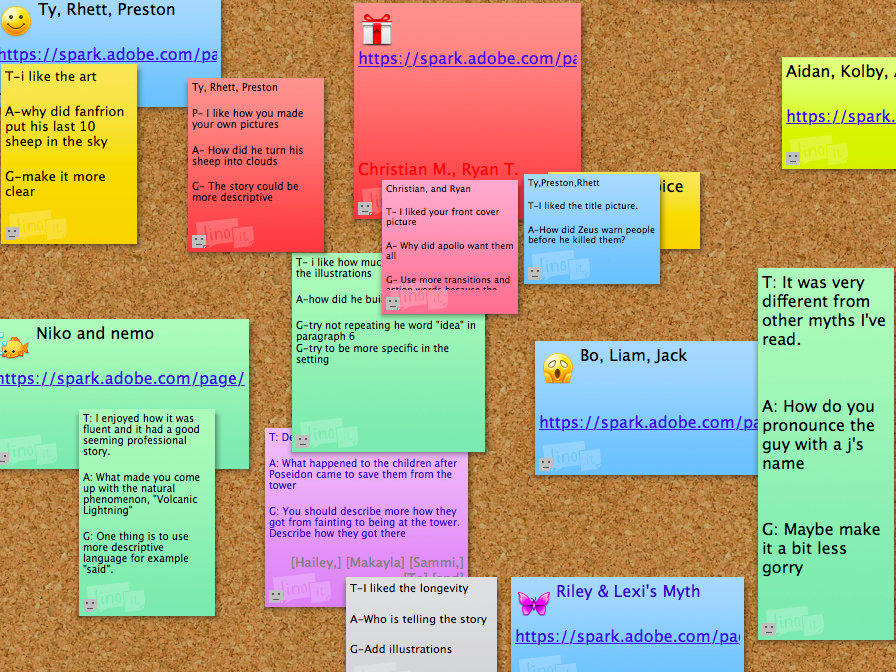
In years past, students completed this project using paper and art supplies. It’s always been a project students love, but this year, the integration of technology took things to an entirely new level. A common frustration reported previously was the limited time students had to complete the myth. With the use of collaborative tools, students could access their work anytime, anywhere. The increased accessibility, improved the overall quality of the projects and provided students a deeper understanding of the content. While all of these benefits make the project worthwhile, the most meaningful benefit would be the ability to instantly provide students with a global audience. Since the assignment was completed using a digital tool, students were able to link their Adobe Spark Videos or Pages to their ePortfolios. This will be an experience students can look back on and share for years to come.
Monday, October 17, 2016
Writing Process Gone Digital
Teachers and students would easily agree revision is an important part of the writing process; however it is often cumbersome and difficult to accomplish within the constraints of a 45 minute class period. Students in Mrs. Davis’ 8th grade GT class have taken this mundane task to the next level with a little help from Google.
A structured process has been created in order for students to successfully collaborate with their peers as they work through the writing process digitally. Students begin by drafting their original essay in Google Docs and then “share” their document with a classmate for feedback. The partner is able to access the essay and provide “real-time” feedback by utilizing the comment feature available in Google Docs. The student writer is then able to view the feedback and reflect on their own work before progressing to the next stage. As students analyze the comments received, they are able to evaluate changes they should make to their essay. This allows students to take full advantage of the peer revision technique, while maintaining ownership of their writing. Once students are ready to share their published piece of writing with an authentic audience, they can feel confident in knowing their work is polished.

In the example above, Anna and John were partners for the revision of their Definition of a Hero Essay. Anna says one of the greatest benefits of this experience is, "Not having to stop to write on a sticky note or separate piece of paper. Often the comments on paper are unclear. This makes it easier to see the person's feedback and reply." John also expressed his appreciation for the ease of use associated with digital feedback, "The instantaneous collaboration is great! You and your partner can work from anywhere and you can both see what the other is doing."
Research supports the value of peer collaboration and discussion across all content areas and concepts. By providing students the opportunity for peer feedback on their writing, students were able to offer one another constructive critique in order to improve their own communication skills. Extending, receiving, and evaluating feedback is a critical skill for all 21st Century Learners.
Subscribe to:
Posts (Atom)